



When selecting bearings for industrial equipment, many buyers face a common question:
What do the numbers and letters on a bearing mean?
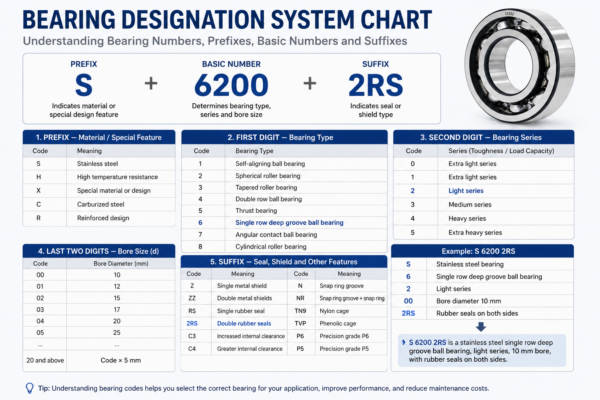
Every bearing has a unique identification code, usually consisting of numbers and letters. This bearing designation provides important information about the bearing type, dimensions, internal structure, sealing method, and material.
Understanding how to read bearing numbers helps engineers, distributors, and purchasing managers select the correct bearing model and avoid costly mistakes.
In this article, USU Bearings explains the meaning of bearing numbers using S 6200 2RS as an example.

What Information Is Included in a Bearing Number?
A typical bearing code contains three main parts:
Prefix + Basic Bearing Number + Suffix
For example:S 6200 2RS
The bearing designation can be divided as follows:
| S 6200 2RS | ||||||
|---|---|---|---|---|---|---|
| Part | Code | Meaning | ||||
| Prefix | S | Bearing material or special design feature | ||||
| Basic Number | 6200 | Bearing type, series and bore size | ||||
| Suffix | 2RS | Seal configuration | ||||
By understanding each part, you can quickly identify the specifications of a bearing.
1.Understanding the Bearing Prefix
The prefix is usually placed before the main bearing number.
It is used to describe special materials, designs, or manufacturing features defined by the bearing manufacturer.
For example: S 6200 2RS
The prefix “S” indicates that the bearing is made with stainless steel components.
Stainless steel bearings are commonly used in applications requiring:
· Corrosion resistance
· Clean operating environments
· Moisture resistance
· Food processing equipment
· Chemical machinery
Different manufacturers may use different prefixes, so buyers should always confirm the meaning with the bearing supplier before ordering.
| Common bearing type codes | ||||||
|---|---|---|---|---|---|---|
| First Digit | Bearing Type | |||||
| 1 | Self-aligning ball bearing | |||||
| 2 | Spherical roller bearing | |||||
| 3 | Tapered roller bearing | |||||
| 4 | Double row ball bearing | |||||
| 5 | Thrust bearing | |||||
| 6 | Single row deep groove ball bearing | |||||
| 7 | Cylindrical roller bearing | |||||
| 8 | Cylindrical roller bearing | |||||
2. Understanding the Basic Bearing Number
The basic bearing number is the most important part of bearing identification.
In our example:6200
The basic number contains information about:
· Bearing type
· Bearing series
· Bore diameter
Let’s analyze each number step by step.
The First Digit: Bearing Type
The first digit of the bearing number indicates the bearing category.
Common bearing type codes include:
| Common bearing type codes | ||||||
|---|---|---|---|---|---|---|
| First Digit | Bearing Type | |||||
| 1 | Self-aligning ball bearing | |||||
| 2 | Spherical roller bearing | |||||
| 3 | Tapered roller bearing | |||||
| 4 | Double row ball bearing | |||||
| 5 | Thrust bearing | |||||
| 6 | Single row deep groove ball bearing | |||||
| 7 | Cylindrical roller bearing | |||||
| 8 | Cylindrical roller bearing | |||||
In our example:6200
The first digit is:6,This means the bearing is a Single row deep groove ball bearing
Deep groove ball bearings are the most widely used bearing type because they can support both radial and moderate axial loads.
The Second Digit: Bearing Series
The second digit represents the bearing series.
The series indicates the bearing’s load capacity, size and strength.
For example:6200,the second digit is“2”,this represents a light series bearing.
| Common bearing series classifications | ||||||
|---|---|---|---|---|---|---|
| Series Code | Description | |||||
| 1 | Extra light series | |||||
| 2 | Light series | |||||
| 3 | Medium series | |||||
| 4 | Heavy series | |||||
A higher series number usually means a stronger bearing with higher load capacity.
The Last Two Digits: Bearing Bore Size
The last two digits indicate the bearing bore diameter (inner diameter).
| standard metric bearings | ||||||
|---|---|---|---|---|---|---|
| Code | Bore Diameter | |||||
| 00 | 10 mm | |||||
| 01 | 12 mm | |||||
| 02 | 15 mm | |||||
| 4 | 17mm | |||||
| 04 and above | Code × 5 mm | |||||
The suffix appears after the basic bearing number.
It describes additional features such as:Seal type、Shield type、Internal clearance、Lubrication、Special design.
In our example:2RS,the suffix means:Two rubber seals on both sides of the bearing.
Explanation:
| Bearing Suffix Codes | ||||||
|---|---|---|---|---|---|---|
| Code | Meaning | |||||
| Z | Single metal shield | |||||
| ZZ | Double metal shields | |||||
| RS | Single rubber seal | |||||
| 2RS | Double rubber seals | |||||
| C3 | Increased internal clearance | |||||
The 2RS sealed bearing is widely used because the rubber seals help prevent:
· Dust contamination
· Moisture entering the bearing
· Lubricant leakage
Complete Meaning of S 6200 2RS
After decoding all parts, we can understand the full bearing specification:
S 6200 2RS means:
- S → Stainless steel bearing design
- 6 → Single row deep groove ball bearing
- 2 → Light series
- 00 → 10 mm bore diameter
- 2RS → Rubber seals on both sides
Therefore:
S 6200 2RS is a stainless steel single row deep groove ball bearing, light series, with a 10 mm inner diameter and double rubber seals.

How Can USU Bearings Help You Choose the Right Bearing?
As a professional bearing supplier in China, USU Bearings provides deep groove ball bearings, tapered roller bearings, angular contact bearings, cylindrical roller bearings, and customized OEM bearing solutions.
We support:
· Standard bearing supply
· OEM/private label service
· Customized packaging
· Technical consultation
If you are unsure about a bearing model, simply send us:
· Bearing number
· Application information
· Required quantity
Our team can help you confirm the correct bearing solution.