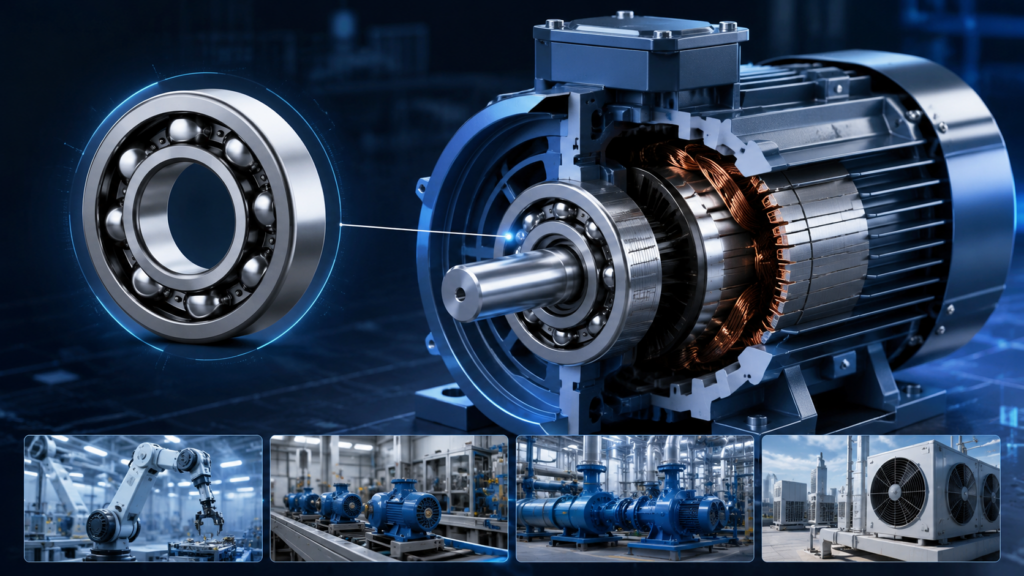




Wuxi USU Bearing has been engaged in bearing production and manufacturing for many years, focusing on the R&D and application of various bearings. We fully recognize that bearing designations are the core basis for model selection, procurement and maintenance.
Many practitioners are often confused by complicated bearing codes and fail to figure out the meaning of each number and letter. For this reason, Wuxi USU Bearing compiles this popular science handbook on bearing designations, systematically elaborating core knowledge including classification of bearing codes, national standards, prefix and suffix codes. It is easy to understand and highly practical. Feel free to collect it for instant reference anytime.
I. Core Bearing Classification (Interpretation of the 1st / First Two Digits)
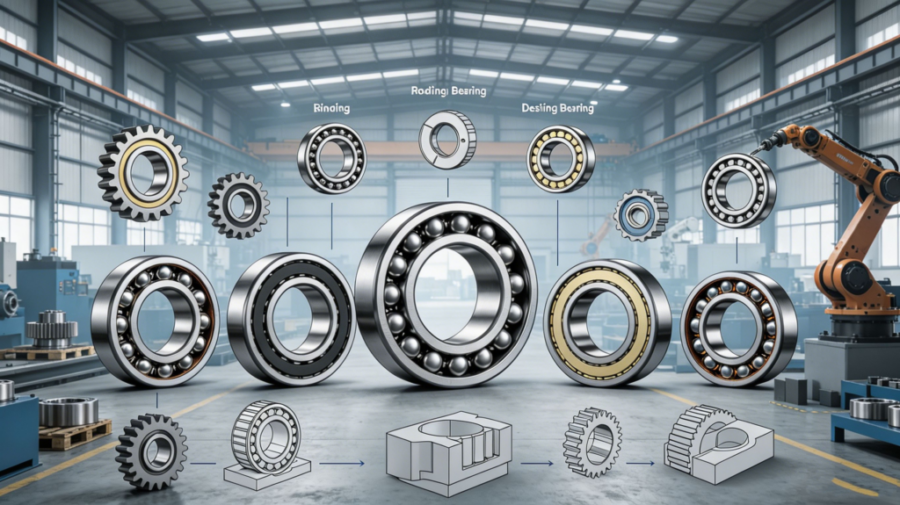
The core identification rule of bearing codes lies in the first digit or the combination of the first two digits from the left. Different combinations stand for distinct bearing types, which is the fundamental and most commonly used method for daily bearing selection.
6: Deep Groove Ball Bearing (Type 0). Widely applied in motors, household appliances, automobile wheel hubs and other scenarios. USU covers all conventional mass-production models.
4: Double-row Deep Groove Ball Bearing (Type 0). Higher load capacity than standard deep groove ball bearings, suitable for heavy-load equipment.
1 / 2: Self-aligning Ball Bearing (Type 1). Normally marked with four basic digits, capable of automatic self-alignment, ideal for shafts with deflection or installation deviation.
21/22/23/24: Spherical Roller Bearing (Type 3). Featuring strong load capacity and self-aligning performance, widely used in mines, wind power equipment, vibrating screens and other heavy-duty working conditions.
N: Cylindrical Roller Bearing (Type 2), including short cylindrical roller bearings and partial needle roller bearings, outstanding in radial load bearing capacity.
Sub-codes of Cylindrical Roller Bearings
NU: Inner ring without ribs
NJ: Inner ring with single rib
NF: Outer ring with single rib
N: Outer ring without ribs
NN: Double-row cylindrical roller bearing without outer ring ribs
NNU: Double-row cylindrical roller bearing without inner ring ribs
Needle Roller Bearings (Type 4)
Roller length is at least 5 times its diameter, main sub-types:
NA: Drawn outer ring needle roller bearing
NK: Stamped outer shell needle roller bearing
K: Needle roller and cage assembly (no inner & outer rings)
7: Angular Contact Ball Bearing (Type 6). High precision, suitable for high-speed equipment such as machine tool spindles and precision instruments. USU supports customized contact angles.
3: Metric Tapered Roller Bearing (Type 7). Able to bear combined radial and axial loads, commonly used in automobile wheel hubs and construction machinery.
51/52/53: Thrust Angular Contact Ball Bearing (Type 8), marked with five basic digits, applicable to equipment bearing both radial and axial loads.
81: Thrust Short Cylindrical Roller Bearing (Type 9). Mainly bearing axial loads, fit for low-speed and heavy-load occasions.
29: Spherical Thrust Roller Bearing (Type 9). Excellent axial load capacity and self-aligning property, widely used in hydroelectric generators and heavy machinery.
II. National Standards for Bearings (Must-read for Selection & Procurement)
Bearing production, inspection and selection shall comply with national and industrial standards. Below are commonly adopted standards for reference:
GB/T 305-1998 Rolling bearings — Snap ring grooves and snap rings on outer rings — Dimensions and tolerances
GB/T 308-2002 Rolling bearing steel balls
GB/T 309-2000 Rolling bearing needles
GB/T 4661-2002 Rolling bearings — Cylindrical rollers
GB/T 4662-2003 Rolling bearings — Static load rating
GB/T 6391-2003 Rolling bearings — Dynamic load rating and rating life
JB/T 3034-1993 Rolling bearings — Oil-sealed rust-proof packaging
JB/T 3573-2004 Rolling bearings — Measuring method for radial internal clearance
JB/T 6639-2004 Rolling bearing parts — Technical specifications for skeleton nitrile rubber seals
JB/T 6641-2007 Rolling bearings — Residual magnetism and its evaluation method
JB/T 6642-2004 Rolling bearing parts — Measuring and evaluating method for roundness and waviness errors
JB/T 7048-2002 Rolling bearing parts — Engineering plastic cages
JB/T 7050-2005 Rolling bearings — Cleanliness evaluation method
JB/T 7051-2006 Rolling bearing parts — Measurement and evaluation of surface roughness
JB/T 7361-2007 Rolling bearing parts — Hardness test method
JB/T 7752-2005 Technical specifications for sealed deep groove ball bearings
JB/T 8196-1996 Rolling bearings — Residual magnetism of rolling elements and evaluation method
JB/T 8571-1997 Test procedures for dustproof, grease leakage and temperature rise performance of sealed deep groove ball bearings
JB/T 8921-1999 Inspection rules for rolling bearings and components
JB/T 10336-2002 Supplementary technical specifications for rolling bearings and components
JB/T 50013-2000 Test procedures for service life and reliability of rolling bearings
JB/T 50093-1997 Evaluation method for service life and reliability of rolling bearings
III. Bearing Prefix Codes (Supplementary Structural Description)
Prefix codes indicate special bearing structures and reflect installation and combination forms. Rules: Code R is placed directly before basic codes; other prefix codes are separated by a dot.
- : Seat ring of thrust cylindrical roller bearing, e.g. GS.81112
- : Rolling element and cage assembly, e.g. K.81108
R : Bearings without separable inner or outer ring, e.g. RNU207
WS : Shaft ring of thrust cylindrical roller bearing, e.g. WS.81112
IV. Bearing Suffix Codes (Core Detailed Interpretation)
Placed after basic codes, suffix codes specify detailed parameters including internal structure, overall dimensions, sealing type, cage type, tolerance grade, clearance and more. Multiple suffix codes are arranged in fixed order.
1. Internal Structure Suffix Codes
Reflect subtle internal structural changes and affect load capacity, contact angle and other core performances.
A/B/C/D/E: Modified internal structure
Example: 7205C (15° contact angle), 7205E (25° contact angle), 7205B (40° contact angle)
E: Reinforced structure for higher load capacity
VH: Full complement cylindrical roller bearing with roller self-locking
2. Overall Dimension & External Structure Codes
Match diversified installation requirements
DA: Separable double-row angular contact ball bearing with double half inner rings
DZ: Cylindrical outer diameter roller bearing
K: Tapered bore bearing, taper ratio 1:12
K30: Tapered bore bearing, taper ratio 1:30
2LS: Double-row cylindrical roller bearing with double inner rings and double dust shields
N: Bearing with snap ring groove on outer ring
NR: Bearing with snap ring groove and snap ring on outer ring
N2: Four-point contact ball bearing with two outer ring grooves
S: Bearing with lubrication groove and holes on outer ring
X: Dimensions conforming to international standards
Z series: Special technical requirements
ZZ: Roller bearing with two outer ring guide collars
3. Sealing & Dustproof Codes
Adapt to various harsh working environments with dust and moisture
RSR: Single-side rubber seal
2RSR: Double-side rubber seals
ZR: Single-side dust shield
2ZR: Double-side dust shields
ZRN: One side dust shield, one side outer ring snap groove
2ZRN: Double-side dust shields plus outer ring snap groove
4. Cage & Cage Material Codes
Determine bearing operation stability and wear resistance, divided into solid cages and stamped cages
Solid Cage
Steel cage: F, FA, FB, FH, FP, FV etc.
Light metal cage: L, LA, LB, LP etc.
Brass cage: M, MA, MB, MP etc.
Phenolic laminated fabric cage: T, TA, TB, TP etc.
Engineering plastic cage: TN, TNH
Glass fiber reinforced polyamide cage: TV, TVH etc.
Stamped Cage
J: Steel plate stamped cage
JN: Riveted cage for deep groove ball bearings
5. Modified Cage Structure
Numbers added to cage codes represent structural adjustments for transitional use.
6. Cageless Bearings
V: Full complement rolling element bearing
VT: Full complement bearing with spacer elements
7. Tolerance Grade Codes (Dimensional & Rotational Precision)
P0: Standard general precision (omitted in marking)
P6 / P6X / P5 / P4 / P2: Higher precision grades in sequence
SP: Composite precision for double-row cylindrical roller bearings
UP: Ultra-high precision for double-row cylindrical roller bearings
HG: Special high precision for spindle bearings
8. Internal Clearance Codes
Affect bearing flexibility and stability
C1 < C2 < C0(standard, omitted) < C3 < C4 < C5
Combination rule: Tolerance grade + clearance code, e.g. P63 = P6 grade + C3 clearance
Custom clearance: Mark radial clearance after R, axial clearance after A with micron values, e.g. 6210.R10.20
9. Low Noise Bearings
Applied to household appliances and precision equipment
F3: Low-noise large-size bearings
G: Low-noise small-size deep groove ball bearings
10. Heat Treatment Codes (High-temperature Resistance)
S0~S: Different tempering treatments for maximum working temperature from 150℃ to 350℃
11. Special Technical Requirements
Mark customized manufacturing, inspection and structural specifications
12. Matched Bearings & Machine Tool Spindle Bearings
Used for paired installation to guarantee assembly precision
K1~K11: Different paired mounting forms for single/double-direction axial load, back-to-back / face-to-face arrangement
13. Universal Matched Bearings
UA: Slight axial clearance after matching
UO: Zero clearance after matching
UL: Light preload after matching
14. High-precision Spindle Bearing Exclusive Codes
Combined codes of precision grade, cage type and preload for professional machine tool spindles
V. Bearing Selection Guidance from Wuxi USU
Mastering bearing code interpretation enables fast and accurate model selection and reduces errors in procurement and maintenance.
Wuxi USU Bearing Co., Ltd. specializes in the production and customization of full-series bearings including deep groove ball bearings, self-aligning ball bearings, cylindrical roller bearings and angular contact ball bearings. All products are manufactured in strict accordance with international standards. We provide professional selection guidance and customized production services based on actual equipment demands and working conditions.
If you have any questions about bearing code interpretation, model selection, bulk procurement or personalized customization, please feel free to contact us. Our professional engineers will provide one-on-one technical support to help you select and apply bearings properly.
Final Note
Bearing designation is the unique identity mark of bearings, standing for specific structure, performance and applicable scenarios. This handbook covers all core interpretation knowledge with strong practicability for permanent collection.
Adhering to the tenet of Premium Products & Professional Services, Wuxi USU Bearing keeps deep rooting in the bearing industry, supplying cost-effective and highly reliable bearing products for diverse industrial fields to boost efficient industrial operation.