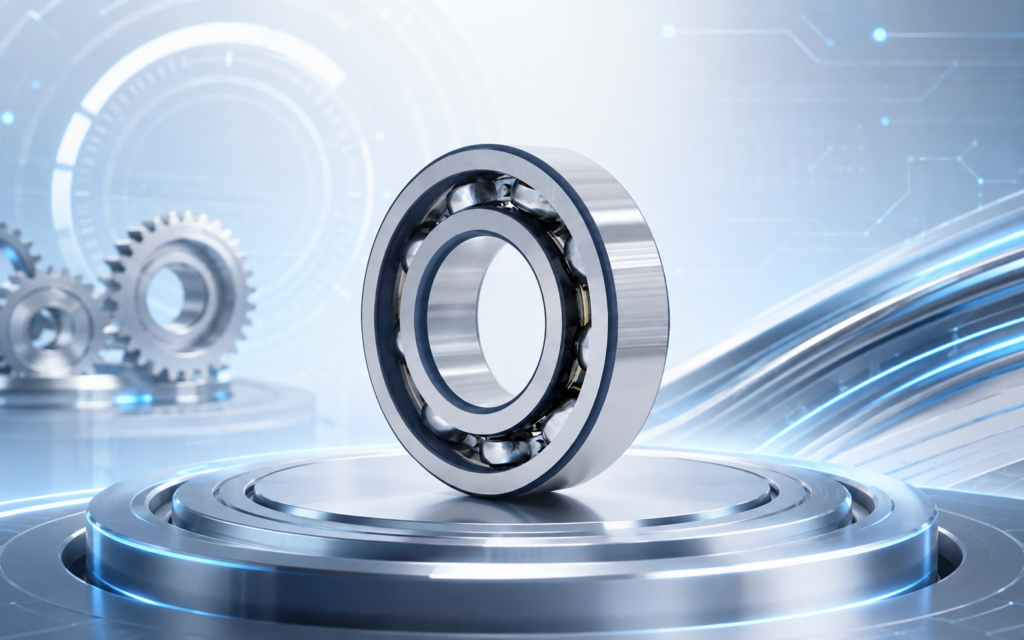




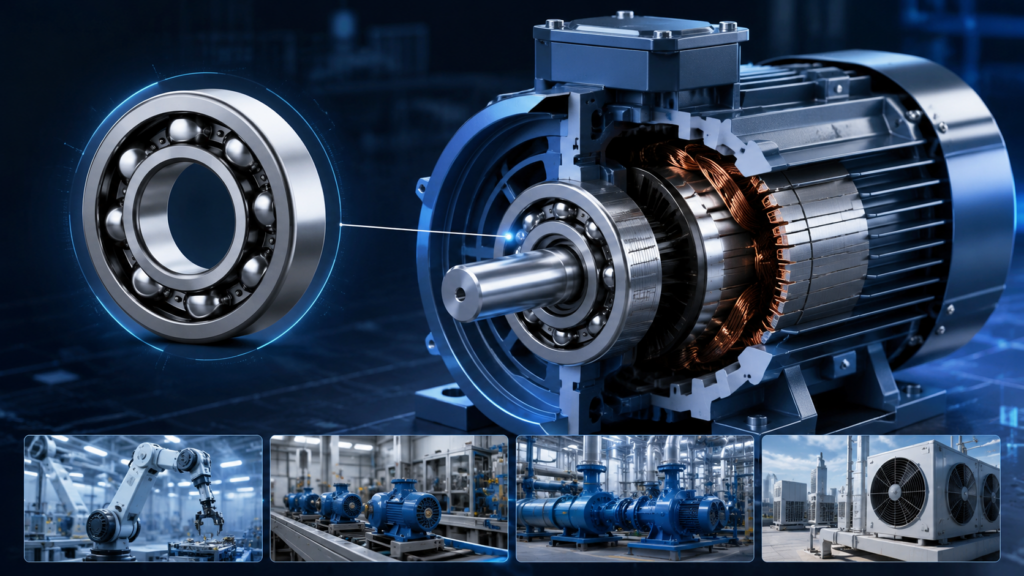
Choosing the right bearing for an electric motor is not simply a matter of picking a bearing that fits the shaft. The fixed-end bearingplays an important role in controlling shaft movement, handling axial loads, and maintaining stable motor operation.
So, how do you choose the right motor fixed-end bearing?
In small and medium-sized motors, deep groove ball bearings are often the first choice.
What Should Be Considered When Selecting a Motor Fixed-End Bearing?
When selecting bearings for the fixed end of an electric motor, three major factors should be considered:
- The required precision of the driven equipment
- The characteristics of the motor load
- The axial load that the bearing or bearing arrangement must withstand
Considering these factors together, deep groove ball bearings are widely used as fixed-end bearings in small and medium-sized electric motors.
The deep groove ball bearing is one of the most commonly used rolling bearings. Its relatively simple structure makes motor bearing systems easy to install, maintain, and service.
A standard deep groove ball bearing is mainly designed to support:Radial loads、Axial loads in both directions
When a bearing with a relatively large radial internal clearance is selected, it can also accommodate combined radial and axial loads to a certain extent, giving it some characteristics similar to angular contact ball bearings.

Advantages of Deep Groove Ball Bearings
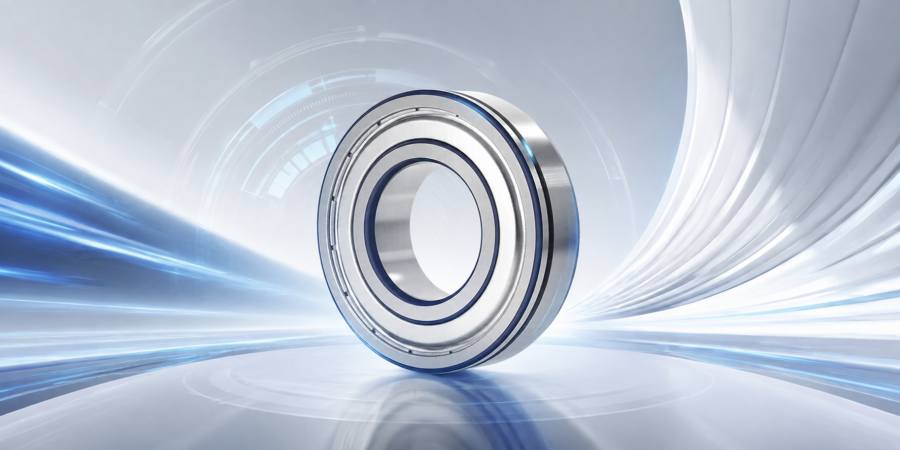
Deep groove ball bearings offer several advantages for electric motor applications:
· Low friction
· High limiting speed
· Easy installation
· Various sealing options
· Ability to accommodate radial and bidirectional axial loads
However, they are not ideal for heavy shock loads or extremely heavy loads. In other words, they are versatile—but even a versatile bearing has its limits.
How Should a Fixed-End Bearing Be Installed?
After the deep groove ball bearing is mounted on the motor shaft, it can control the radial position of both the shaft and housing.
In many applications:
The purpose of this arrangement is to ensure that the bearing operates with zero or slightly negative working clearance under normal operating conditions.
Proper clearance is important because excessive or insufficient clearance can affect bearing temperature, noise, service life, and running stability.
For axial positioning, the relationship between the locating bearing and other components should be determined together with the specific floating-end bearing arrangement.
The inner ring is generally positioned by the shaft shoulder and retaining ring, while the outer ring is controlled by the fit between the bearing and housing, the dimensions of the bearing cover, and the length of the bearing seat.
Fixed-End and Floating-End Bearing Arrangements
The correct arrangement depends largely on the type of bearing used at the floating end.
1.Floating End Uses a Separable Bearing
When the floating-end bearing has separable inner and outer rings, the outer rings of both bearings are generally installed with no axial clearance.
2.Floating End Uses a Non-Separable Bearing
When a non-separable bearing is used at the floating end, a certain amount of axial clearance should be left between the bearing outer ring and the bearing cover shoulder.
At the same time, the fit between the outer ring and bearing housing should not be excessively tight.
This allows the floating end to compensate for thermal expansion of the motor shaft during operation.
3.When the Motor Has No Clearly Defined Fixed or Floating End
If the motor does not have a clearly defined locating end and floating end, deep groove ball bearings are generally used at both ends.
One possible arrangement is to lock the outer ring axially against the inner bearing cover while leaving axial clearance between the outer ring and outer cover.
Another arrangement is to have no axial clearance between the bearing outer ring and outer cover while leaving clearance between the outer ring and inner cover.
The exact arrangement should be determined according to the motor’s actual operating conditions.

Bearing Clearance, Precision and Temperature Resistance Matter
The above arrangements are based on theoretical analysis. In real motor applications, bearing selection should always be matched to the actual operating conditions.
Important factors include:
· Bearing internal clearance
· Temperature resistance
· Radial fit between the bearing and housing
· Radial and axial loads
· Bearing accuracy
· Radial fit between the bearing and shaft
· Motor speed
· Operating temperature
A bearing may have the correct dimensions but still be the wrong choice if its internal clearance, precision, or fit is unsuitable.
The discussion above mainly applies to horizontally mounted electric motors.For vertically mounted motors, bearing selection, axial positioning, load distribution, and fitting relationships may be different and require specific consideration.
Therefore, there is no universal “one bearing fits all” solution. The best motor bearing selection should always be based on the motor’s structure and actual operating conditions.
Conclusion
For many small and medium-sized electric motors, **deep groove ball bearings are a practical and economical choice for the fixed end** because they offer low friction, high-speed capability, simple installation, and the ability to handle both radial and bidirectional axial loads.
However, selecting a motor fixed-end bearing is more than matching the bearing number to the shaft diameter. **Clearance, load, speed, temperature, precision, shaft fit, housing fit, and the floating-end arrangement all need to work together.**
A good bearing does its job quietly. When everything is selected correctly, the motor simply runs—and nobody has to think about the bearing. That’s usually a very good sign.