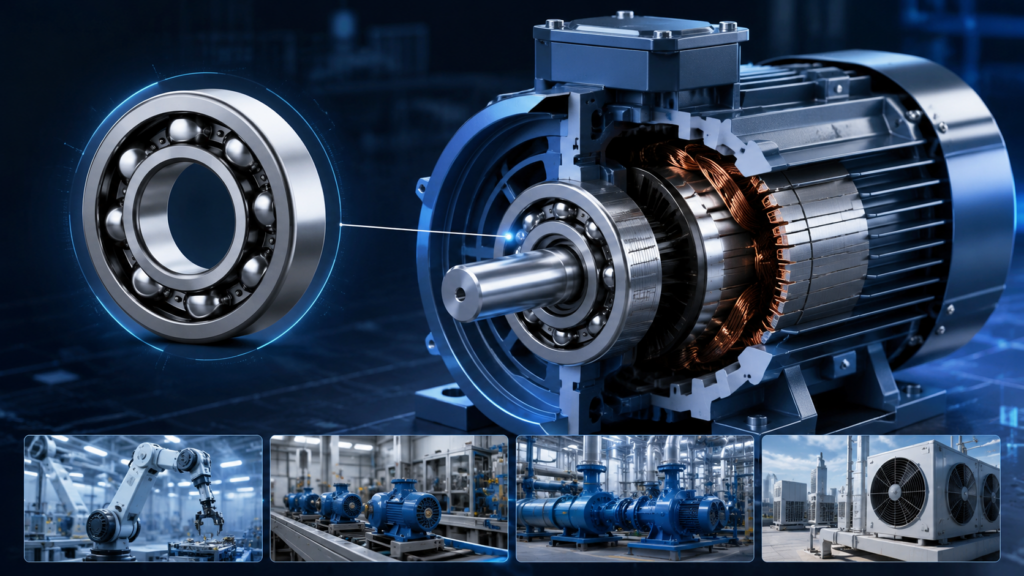




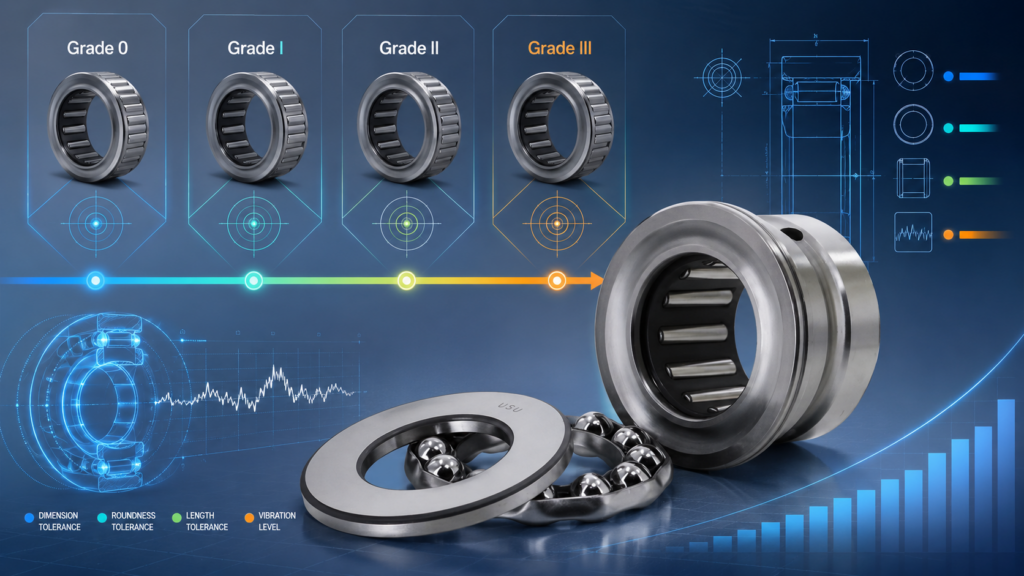
Rollers are an important component of rolling bearings, and their dimensional accuracy and machining quality directly affect the bearing’s rotational accuracy, operational stability, and service life. To ensure the performance requirements of bearings with different accuracy grades, rollers are usually manufactured according to different tolerance grades and used in conjunction with bearings of the corresponding accuracy grades.
For equipment requiring high-speed, high-precision, or low-vibration operation, correctly selecting the roller tolerance grade is crucial.
What is a roller tolerance grade?
A roller tolerance grade refers to the manufacturing precision grade of the roller in terms of diameter, length, roundness, and dimensional consistency.
Different roller grades are suitable for rolling bearings of different precision grades to ensure good rotational accuracy and operational stability of the entire bearing system.
Generally, rolling bearing rollers can be classified into the following four grades:
Roller Grade | Applicable Bearing Precision Grade | Application Characteristics
Grade 0 | P2 | Ultra-high precision equipment, less commonly used
Grade I | P4 | High-precision machine tools, high-speed spindles
Grade II | P5 | Commonly used in precision equipment
Grade III | P6, P0 | Widely used in industrial equipment
Among them, Grade II and Grade III rollers are currently the most common products in industrial production, meeting the requirements of the vast majority of mechanical equipment.
What are the precision grades of needle rollers?
In addition to rollers, the needle rollers in needle roller bearings are also classified according to precision.
Common grades include:G2、G3、G5
The smaller the number, the higher the precision of the needle roller machining, and the stricter the requirements for dimensional consistency and rotational accuracy.
Different grades are mainly selected based on the equipment’s speed, precision, and operating environment.
What are the bearing tolerance grades?
Rolling bearings are typically divided into several precision grades according to international standards.
From ordinary precision to high precision, they include:P0 (Ordinary Grade)、P6、P5、P4
P2 (Ultra-High Precision)
The higher the precision grade, the stricter the control over the bearing’s dimensions, tolerances, radial runout, and rotational accuracy.
Different grades are suitable for different industrial equipment.
P0 Grade
Suitable for general industrial equipment, motors, pumps, speed reducers, conveying equipment, etc., and is the most widely used grade on the market.
P6 Grade
Compared to P0, it has better rotational accuracy and can be used in medium- and high-speed machinery and some automated equipment.
P5 Grade
Suitable for high-speed motors, precision equipment, and some CNC equipment, with higher requirements for vibration and noise.
P4 Grade
Primarily used in high-precision equipment such as high-speed machine tool spindles, precision instruments, and robots.
P2 Grade
This is an ultra-high precision grade, widely used in aerospace, precision testing equipment, and specialized industrial fields.
How to Choose the Appropriate Roller Tolerance Grade?
A higher roller grade is not always better; the selection should be based on the equipment’s operating conditions.
Generally, the following principles are recommended:
Ordinary industrial equipment: Select Grade III rollers, corresponding to P0 or P6 grade bearings.
Automated equipment and high-speed equipment: Grade II rollers can be selected, corresponding to P5 grade bearings.
High-precision machine tools and robots: Grade I rollers are recommended, corresponding to P4 grade bearings.
Aerospace and ultra-precision equipment: Use Grade 0 rollers, corresponding to P2 grade bearings.
Appropriately matching roller grades with bearing precision not only ensures equipment performance but also effectively controls procurement costs.
USU Bearings Rolling Bearing Solutions
USU Bearings provides customers with rolling bearing products of various precision grades to suit different equipment operating conditions.
Our services include:
Supply of bearings in various precision grades such as P0, P6, P5, and P4
Quality control of key components such as rollers and needle rollers
High-speed, low-noise, and high-precision bearing solutions
OEM brand customization
Bearing selection and technical consultation
Global industrial application support
Whether for general machinery or high-precision automated equipment, USU Bearings can provide stable and reliable bearing products and professional technical support.
Conclusion
Roller tolerance grade is one of the important factors determining the performance of rolling bearings, and it is closely related to the bearing precision grade. Correctly selecting the roller grade and bearing precision can not only improve the stability of equipment operation but also effectively extend the bearing’s service life and reduce maintenance costs.
As a professional bearing supplier, USU Bearings is committed to providing global customers with high-quality rolling bearing products and comprehensive technical services, helping customers obtain more efficient and reliable transmission solutions under different operating conditions.