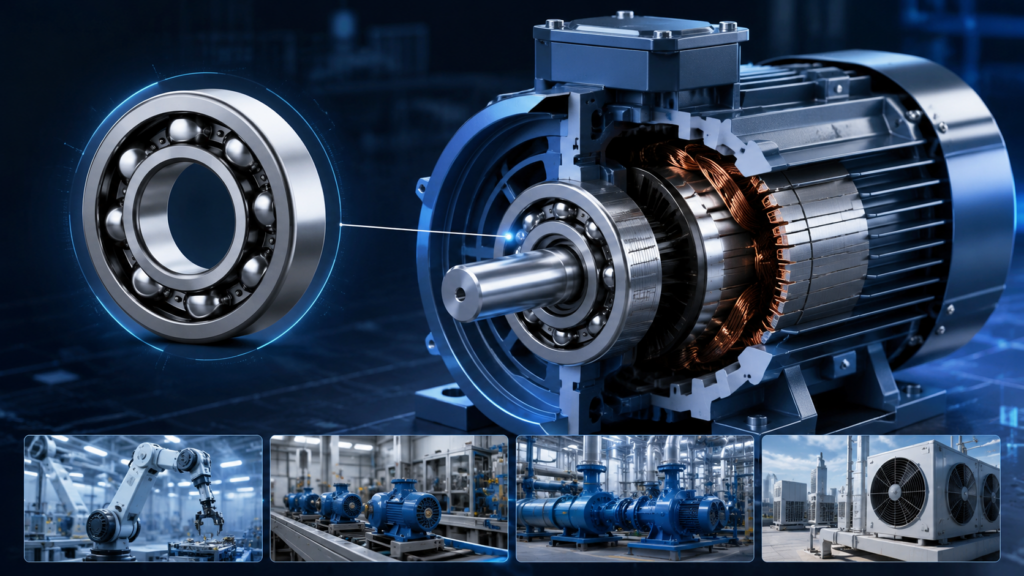




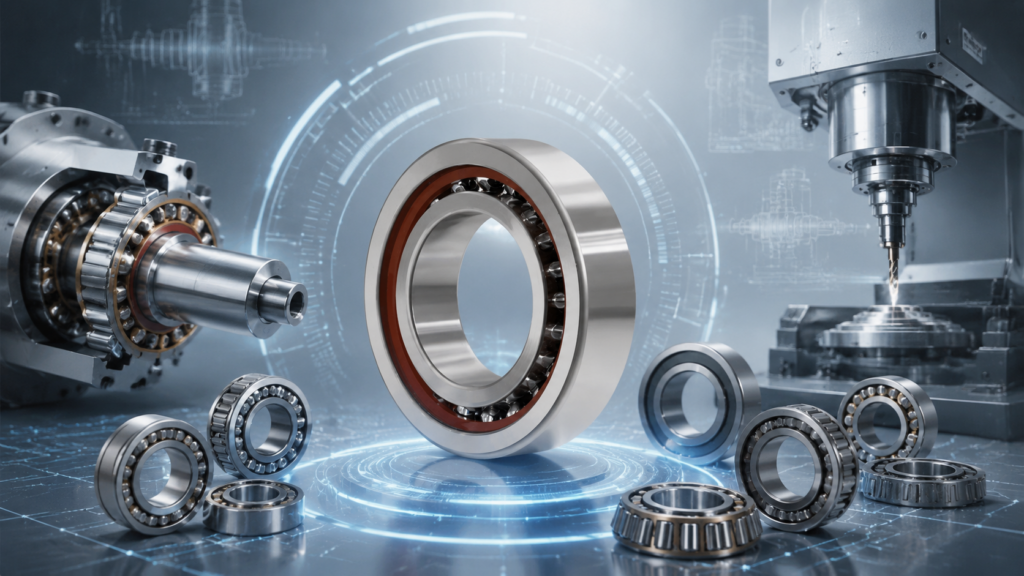
The spindle is a core component in machine tools, machining centers, high-speed electric spindles, and precision equipment. The spindle bearing directly determines the machining accuracy, rotational speed, load-bearing capacity, and overall stability of the equipment.
Different equipment operates under significantly different conditions; therefore, there is no single, universally applicable selection scheme for spindle bearings. Only by combining the equipment’s speed, load, stiffness, and precision requirements, and selecting the appropriate bearing type and configuration, can the equipment’s performance be fully utilized.
As a professional bearing supplier, USU Bearings can provide spindle bearing selection advice based on different operating conditions, offering customers stable and efficient bearing solutions.
What factors need to be considered when selecting spindle bearings?
1.Speed Requirements
Speed is usually a crucial factor influencing spindle bearing selection.
High-speed equipment requires bearings with low frictional torque and high limiting speed; therefore, most high-speed spindles prioritize angular contact ball bearings. For medium- and low-speed, heavy-load conditions, roller bearings can be selected to achieve higher load-bearing capacity.
2.Stiffness Requirements
Spindle stiffness directly affects machining accuracy and cutting stability.
Generally speaking:
Roller bearings use a line contact structure, resulting in higher overall stiffness.
Ball bearings have a point contact structure, with relatively lower stiffness, but can meet the requirements of high-speed operation.
Pre-loading multiple sets of angular contact ball bearings can significantly improve system stiffness.
For precision machine tools, a balance between rigidity and high-speed performance is typically required.
3.Load Type
During spindle operation, radial loads, axial loads, or combined loads may occur. Therefore, bearing selection must be based on the load characteristics.
For example:
For large radial loads, cylindrical roller bearings can be selected.
For simultaneous radial and axial loads, angular contact ball bearings or tapered roller bearings can be selected.
For equipment with large axial loads, thrust bearings can be used.
A suitable bearing combination can improve the operational stability of the equipment.
4.Precision Requirements
For CNC machine tools, high-speed grinding machines, and precision machining equipment, bearing precision directly affects machining quality.
High-precision spindles typically use P5, P4, or even higher precision bearings, and improve rotational and positioning accuracy by controlling clearance through proper preload.
Recommended Spindle Bearings for Different Operating Conditions
Medium-Speed Heavy-Duty Equipment
For equipment requiring high rigidity and load-bearing capacity, the following bearings are preferred:
Double-row cylindrical roller bearings
Tapered roller bearings
These bearings can withstand large radial loads and are suitable for heavy cutting conditions.
High-Speed Machining Equipment
High-speed spindles typically use angular contact ball bearings.
Through paired or multiple preloaded installations, they can maintain high speeds while also ensuring a certain level of rigidity, and are widely used in:
CNC machine tools
Machining centers
High-speed grinding machines
Precision spindles
Equipment with Large Axial Loads
When the spindle bearing is subjected to large axial forces, the following bearings can be used:
Angular contact ball bearings
Thrust angular contact ball bearings
Tapered roller bearings
A proper combination can effectively improve axial positioning accuracy.
Space-Constrained Equipment
For equipment with limited installation space and restricted radial dimensions, consider:
Needle roller bearings
Small precision ball bearings
These bearings can provide high load-bearing capacity within limited installation space.
Common Spindle Bearing Types
Angular Contact Ball Bearing
Features:
High speed, high precision, can withstand radial and axial loads, supports preload installation
Main Applications:
High-speed machine tools, machining centers, electric spindles.
Double Row Cylindrical Roller Bearing
Features:
High rigidity, high load capacity, low heat generation
Main Applications:
Lathes, boring machines, heavy-duty machine tools.
Tapered Roller Bearing
Features:
Can withstand radial and axial loads simultaneously, high support rigidity, compact structure
Main Applications:
Heavy-duty machine tools, construction machinery, and large equipment.
Deep Groove Ball Bearing
Features:
Simple structure, low cost, suitable for medium to high speed operation
Main Applications:
Light-load spindles, auxiliary support parts.
Needle Roller Bearing
Features:
Small cross-section, high load capacity, saves installation space
Main Applications:
Multi-axis equipment, small machinery, and special structure spindles.
Spindle Bearing Selection Recommendations
To achieve better machining accuracy and bearing life, we recommend focusing on the following aspects:
Select the appropriate bearing type based on the rotational speed.
Design the bearing combination rationally based on the load.
Select the corresponding precision grade based on the machining accuracy.
Properly set the preload to avoid excessive temperature rise.
Use appropriate lubrication and sealing solutions to improve operational reliability.
Scientific bearing selection can effectively reduce vibration, reduce wear, and extend the overall service life of the spindle.
USU Bearings Spindle Bearing Solutions
USU Bearings provides professional spindle bearing products and technical support for machine tool manufacturers, automation equipment companies, and industrial customers.
Our services include:
Spindle bearing selection recommendations
High-speed, high-precision bearing configuration solutions
Bearing combination design for different operating conditions
OEM customization services
Lubrication and installation technical support
Stable global supply
Whether it’s a high-speed machining center or heavy-duty industrial equipment, USU Bearings can provide suitable spindle bearing solutions.
Conclusion
The selection of spindle bearings not only affects the speed and load capacity of the equipment, but also directly impacts machining accuracy, operational stability, and equipment lifespan.
In practical applications, speed, rigidity, load, accuracy, and installation conditions should be comprehensively considered to select the most suitable bearing type and configuration.
USU Bearings adheres to the philosophy of “superior attitude, superior quality, superior service,” providing global customers with high-quality spindle bearings and professional technical support to help equipment achieve higher efficiency, higher precision, and longer service life.