



Spherical plain bearings are a specialized class of bearings capable of simultaneously accommodating radial loads, axial loads, and tilting moments, with the direction of force serving as the core criterion for type selection. In industrial applications, choosing the right spherical plain bearing can significantly enhance the stability, precision, and operational lifespan of mechanical equipment.
Spherical plain bearings are primarily classified into the following five categories.
1. Classification by Load Direction and Contact Angle
This is the most fundamental classification method for spherical plain bearings, directly determining their load-carrying performance in actual operations.
Radial Spherical Plain Bearings: Primarily designed to bear radial loads (with a contact angle of $0^\circ \le \alpha \le 30^\circ$).
Radial Contact Type ($0^\circ$): Mainly handles radial loads but can accommodate a small amount of axial load.
Angular Contact Type ($0^\circ < \alpha \le 30^\circ$): Capable of bearing combined radial and axial loads simultaneously.
Thrust Spherical Plain Bearings: Primarily designed to bear axial loads (with a contact angle of $30^\circ < \alpha \le 90^\circ$).
Axial Contact Type ($90^\circ$): Specifically engineered to withstand pure axial loads.
Angular Contact Type ($30^\circ < \alpha < 90^\circ$): Primarily withstands axial loads while accommodating limited radial loads (typically not exceeding 0.5 times the axial load).
2. Classification by Outer Ring Structure
Different outer ring designs determine the installation method and load characteristics of the bearing. They are divided into:
Solid (Integral) Outer Ring Bearings
Single-Slit Outer Ring Bearings
Double-Slit (Split) Outer Ring Bearings
Two-Piece (Double-Half) Outer Ring Bearings
3. Classification by Integral Rod Ends
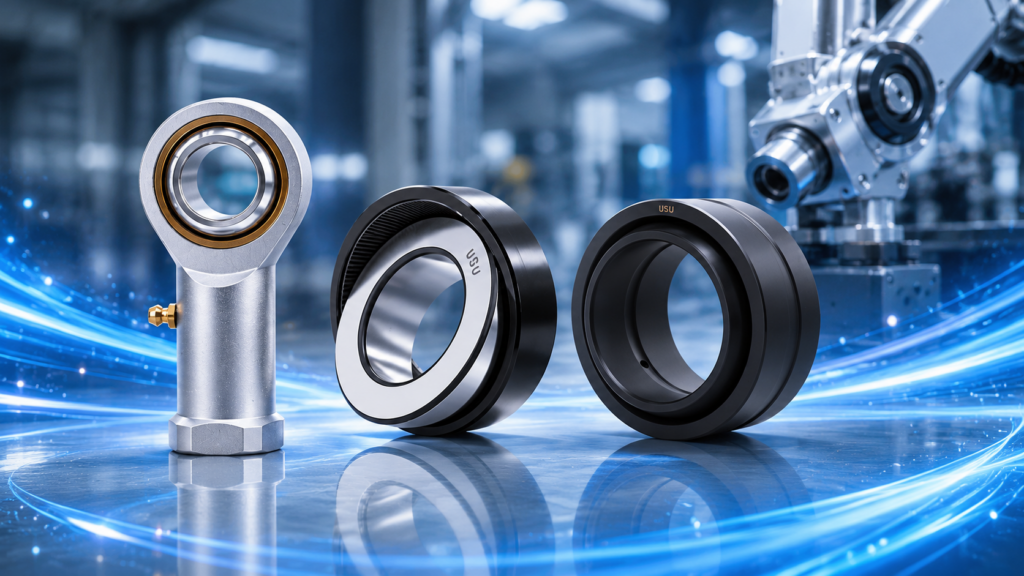
Standard Spherical Plain Bearings: Used independently, these can be installed separately within mechanical linkages and slewing mechanisms.
Rod End Spherical Plain Bearings: Integrated directly onto the end of a rod or shaft. They are widely utilized in hydraulic systems, mechanical linkages, and automation equipment.
4. Classification by Lubrication Method
The lubrication method directly impacts the maintenance costs and service life of the bearing.
Lubricated Spherical Plain Bearings (Steel-on-Steel): Require regular grease or oil lubrication maintenance.
Self-Lubricating Spherical Plain Bearings: Maintenance-free or low-maintenance units. An increasing number of modern machinery designs favor this structure to reduce downtime.
5. Comprehensive Classification
In practical selection, engineers typically combine load direction, structural design, and application purposes to categorize these bearings into four main types: Radial Spherical Plain Bearings, Angular Contact Spherical Plain Bearings, Thrust Spherical Plain Bearings, and Rod End Bearings.
Core Selection Principle: First clarify the direction of force, then evaluate the load capacity and structural constraints.
Conclusion
The key to selecting the right spherical plain bearing lies in a precise understanding of the load direction and actual working conditions. Grasping the characteristics of each classification helps equipment designers and maintenance engineers make scientifically backed selections for mechanical linkages, hydraulic cylinders, and industrial automation—ensuring optimal equipment stability and durability.
As a long-term partner in the industrial sector, 无锡 USU 轴承 provides a comprehensive range of spherical plain bearing products and expert technical support services. For more selection guides or customized application solutions, please feel free to contact 无锡 USU 轴承 for further assistance.