



1. Definition of Spherical Roller Bearings
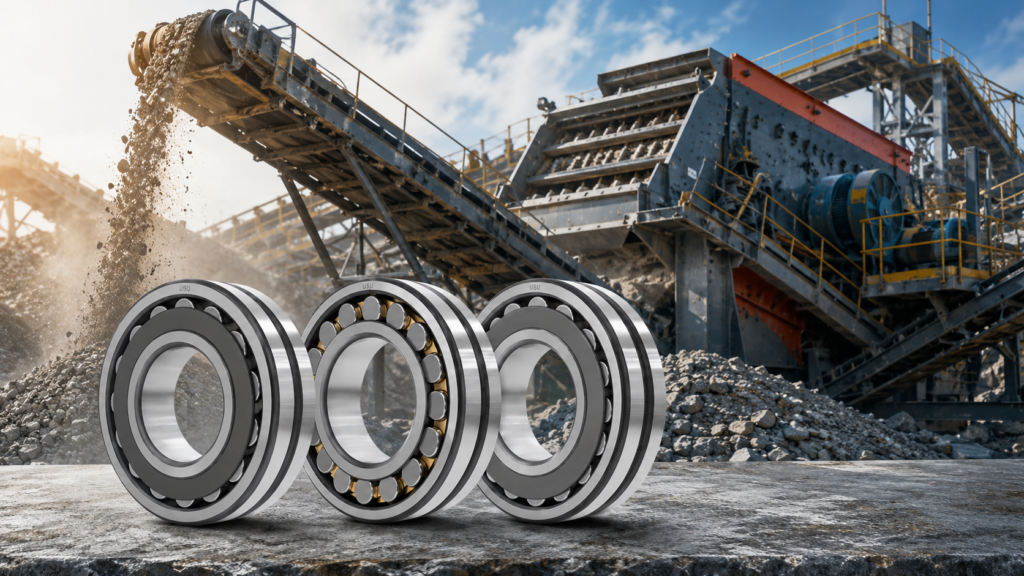
Spherical roller bearings are double-row heavy-duty self-aligning rolling bearings. They adopt barrel rollers instead of steel balls, and feature the classic structure consisting of spherical outer ring raceways and double inclined inner ring raceways.
With three core advantages — superb radial load capacity, bidirectional axial load capacity and automatic self-aligning performance, they are the optimal bearing choice for heavy-load, vibration-prone and misalignment-prone working conditions such as mining machinery, wind power equipment, vibrating screens and metallurgical rolling mills.
Compared with ordinary ball bearings, they apply line contact instead of point contact, which multiplies the contact area and greatly enhances load-bearing capacity. The unique spherical and barrel-shaped structure can automatically compensate for installation errors, shaft deflection and bearing housing misalignment, enabling long-term stable operation under harsh working conditions.
2. Structural Composition and Self-aligning Principle
Spherical roller bearings are non-separable double-row bearings, mainly composed of four key components: solid outer ring, inner ring, two rows of barrel rollers and high-strength cages, featuring stable structure and excellent impact resistance.
- Outer Ring: Designed with a single large spherical raceway whose center of curvature coincides with the bearing center, acting as the core part to realize self-alignment.
- Inner Ring: Equipped with two inclined raceways at a certain angle to the shaft axis, guiding the rolling of each row of rollers respectively.
- Barrel Roller: Adopts symmetrical barrel shape with bulged middle part and narrowed two ends. It makes line contact with raceways to ensure uniform stress distribution, strong load capacity and flexible adaptation to self-aligning angles.
- Cage: Mostly made of stamped steel plate (Type C/CC) or solid copper alloy (Type CA). It separates rollers evenly to avoid friction and fits medium and high-speed operation.
Self-aligning Principle
The combination of spherical outer ring and barrel rollers allows a relative inclination of 1° to 2° between inner and outer rings. It can automatically compensate for shaft bending, bearing housing deformation and installation misalignment, effectively preventing bearing seizure and premature wear.
3. Main Models and Structural Classification
Standard spherical roller bearings are mainly classified into the 20000 series. They are categorized by inner bore shape, roller structure and cage type to meet diverse requirements for different loads, rotating speeds and installation methods.
3.1 Classification by Inner Bore Shape
- Cylindrical Bore (Standard Type): Straight inner bore suitable for standard shaft mounting, represented by 22200 and 22300 series.
- Tapered Bore (K/K30 Type): Inner bore with 1:12 (K) or 1:30 (K30) taper. Matched with adapter sleeves or withdrawal sleeves, it can be quickly installed on plain shafts and facilitates clearance adjustment.
3.2 Classification by Cage and Roller Structure
- Type C / CC: Equipped with symmetrical barrel rollers and stamped cages; inner ring without ribs or with middle ribs. Cost-effective and suitable for general heavy-load working conditions.
- Type CA: Fitted with symmetrical barrel rollers and solid copper cages, with ribs on both sides of the inner ring. It features high strength and high temperature resistance, ideal for high-speed, impact and high-temperature environments.
- Type VB: Reinforced structure specially designed for vibrating screens, with outstanding vibration resistance and fatigue resistance for high-frequency vibration scenarios.
3.3 Special Suffix Codes
- /W33: Outer ring with annular oil groove and 3 lubrication holes for easy lubrication, applicable to continuous high-speed and high-temperature operation.
4. Core Performance Characteristics
4.1 Ultra-high Heavy-load Bearing Capacity
The line-contact design of barrel rollers enables 3 to 5 times higher radial load capacity than self-aligning ball bearings of the same specification, capable of bearing heavy loads and impact loads for extreme load-bearing scenarios in mining, metallurgy and other industries.
4.2 Automatic Self-alignment to Adapt to Installation Errors
The matching design of spherical raceways and barrel rollers allows an inclination deviation of 1°~2°, which offsets shaft deflection, bearing housing deformation and installation misalignment. It lowers installation precision requirements and reduces failure risks.
4.3 Capable of Bearing Combined Loads
It can withstand huge radial loads, bidirectional axial loads as well as combined radial and axial loads, perfectly adapting to complex working conditions where axial force and radial force coexist.
4.4 Vibration Resistance, Impact Resistance and Long Service Life
Manufactured from high-purity GCr15 bearing steel with quenching hardness reaching 58-64HRC. The robust structure ensures minimal deformation under heavy loads. The barrel-shaped structure reduces edge stress, bringing excellent wear resistance and fatigue resistance. It can operate stably for a long time with correct lubrication.
4.5 Adaptable to Medium & High Speed and High Temperature
It features low friction coefficient and higher limiting rotating speed than ordinary heavy-duty bearings. Adopting premium materials and professional heat treatment technology, it can work stably under a maximum ambient temperature of 200℃, suitable for continuous operation under high-speed and high-temperature conditions.
5. Typical Application Scenarios
Endowed with core advantages of heavy-load bearing capacity, automatic self-alignment and vibration resistance, spherical roller bearings are widely used in mining, wind power, metallurgy, building materials, papermaking, construction machinery and other industries.
- Mining Machinery: Vibrating screens, crushers, ball mills and belt conveyors to bear heavy loads, high-frequency vibration and impact loads.
- Wind Power Equipment: Wind turbine main shafts and gearboxes to withstand wind load impact, shaft deflection and installation misalignment.
- Metallurgical Equipment: Steel rolling mills, continuous casters and extruders for high-temperature, heavy-load and impact working conditions.
- Building Materials & Chemical Industry: Coal pulverizers, cement mills and extruders, applicable to harsh environments with heavy load, vibration and dense dust.
- General Machinery: Large reducers, papermaking machinery, marine propulsion systems and engineering machinery bearing combined loads and vibration.
Conclusion
As an indispensable core component integrating heavy-load bearing, automatic self-aligning and vibration-resistant functions, spherical roller bearings are known as the “heavy-load core” essential for mining, wind power, metallurgy and vibration equipment.
Supported by professional technology, superior quality and stable delivery, USU Bearings provides customers with cost-effective spherical roller bearing solutions, helping all kinds of heavy machinery run efficiently and steadily.
Please feel free to contact us for model selection, procurement and customized bearing services.