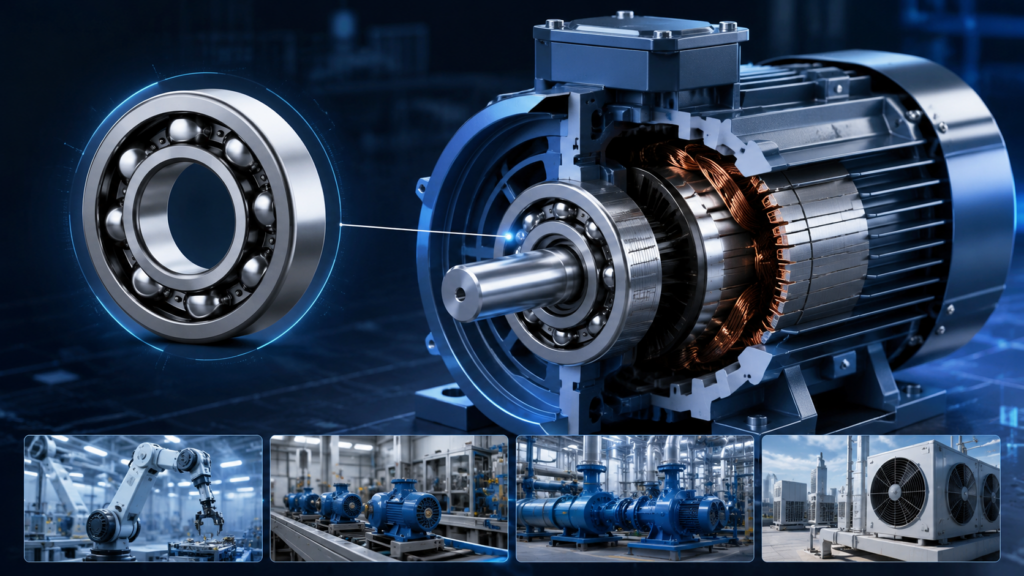




As industrial equipment continues to evolve toward higher speeds and greater precision, bearings are subjected to increasingly demanding operating conditions. From high-speed motorized spindles and aircraft engines to electric vehicle drive systems, bearing speeds have risen from a few thousand revolutions per minute to tens or even hundreds of thousands of RPM.
However, as rotational speed increases, the internal force conditions within a bearing change fundamentally. Rolling elements are no longer subjected solely to external loads; they are also influenced by two important inertial forces: centrifugal force and gyroscopic moment. These invisible forces directly affect load distribution, temperature rise, friction, and bearing service life.
Why Do High-Speed Bearings Face New Challenges?
Under normal operating speeds, bearing load analysis is relatively straightforward. Rolling elements mainly carry radial and axial loads transmitted from the machine.
When speed enters the high-speed range, however, the motion of rolling elements becomes much more complex. Each ball or roller not only revolves around the bearing center but also rotates rapidly around its own axis.
As speed continues to increase, inertia-generated forces become significant factors affecting bearing performance. Among them, the two most critical inertial effects are:
Centrifugal Force
Gyroscopic Moment
Centrifugal Force: Continuously Pushing Rolling Elements Toward the Outer Ring
Centrifugal force is one of the most common inertial loads in high-speed bearings.
Its principle is similar to that of a high-speed spin dryer. As rolling elements rotate around the bearing center, they experience a continuous outward inertial force.
An important characteristic of centrifugal force is that it does not increase linearly. Instead, it is proportional to the square of rotational speed.
This means:
If bearing speed doubles, centrifugal force increases by approximately four times.
At ultra-high speeds, even a small increase in RPM can significantly alter the internal load distribution.
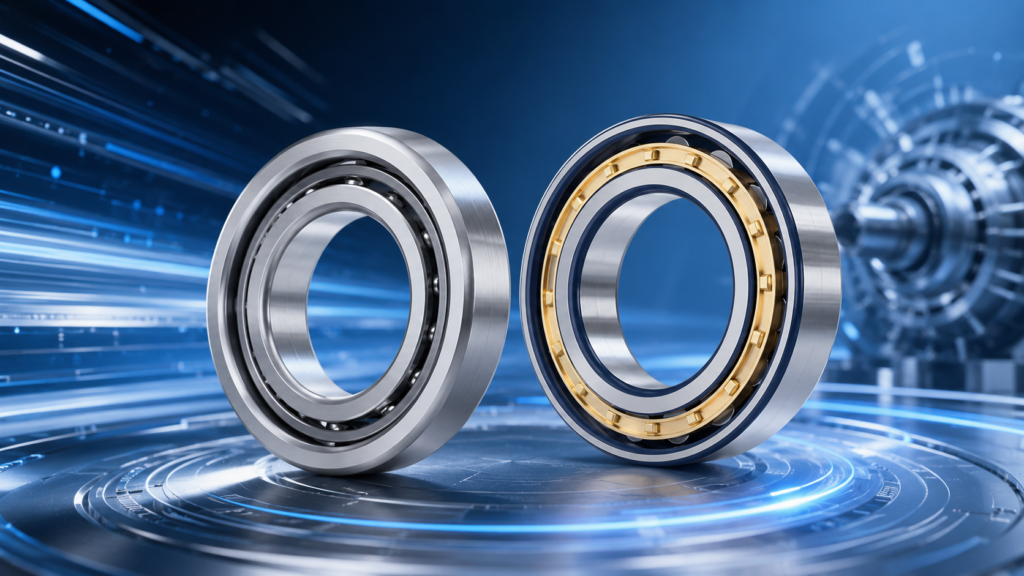
Impact on Angular Contact Ball Bearings
In angular contact ball bearings, centrifugal force changes the contact relationship between the balls and raceways.
Typical effects include:
Increased contact load on the outer raceway
Reduced contact load on the inner raceway
Changes in contact angle
Reduced bearing stiffness
As centrifugal force increases, the load distribution gradually shifts toward the outer raceway, accelerating raceway fatigue and wear.
Impact on Cylindrical Roller Bearings
For cylindrical roller bearings, centrifugal force pushes rollers more firmly against the outer raceway.
Potential consequences include:
Localized overload on the outer raceway
Increased contact stress between rollers and raceways
Higher frictional heat generation
Reduced fatigue life
Gyroscopic Moment: The Hidden Challenge in High-Speed Bearings
If centrifugal force is the most visible influence in high-speed bearings, gyroscopic moment is often the more complex one.
During high-speed operation, rolling elements not only revolve around the bearing center with the cage but also rotate rapidly around their own axes. The combination of these motions generates an inertial moment that tends to alter the direction of the rolling element’s rotational axis. This phenomenon is known as the gyroscopic moment.
How Does Gyroscopic Moment Affect Bearings?
Ideally, rolling elements should maintain pure rolling contact throughout operation.
However, under the influence of gyroscopic moments, rolling elements may deviate from their intended rolling path, leading to:
Localized sliding friction
Increased friction coefficient
Significant temperature rise
Lubrication film degradation
Accelerated surface wear
In high-speed angular contact ball bearings, gyroscopic effects are often one of the key factors influencing running accuracy and stability.
The Combined Effect of Centrifugal Force and Gyroscopic Moment
In real operating conditions, these two inertial effects rarely exist independently. High-speed bearings are typically subjected to both centrifugal force and gyroscopic moment simultaneously.
This complex mechanical interaction can result in:
Redistribution of internal loads
Changes in contact stress
Deterioration of lubrication conditions
Increased frictional heat generation
Higher vibration levels
As a result, the design of high-speed bearings is considerably more complex than that of conventional bearings.
Engineers must evaluate not only external loads but also the internal inertial forces generated during high-speed operation.
Why Are Ceramic Ball Bearings Increasingly Used in High-Speed Applications?
To reduce the negative effects of centrifugal force and gyroscopic moments, many high-speed machines now utilize hybrid ceramic bearings.
The most common configuration consists of:
Silicon nitride (Si₃N₄) ceramic balls
Steel bearing rings and raceways
Compared with traditional steel balls, ceramic balls offer several advantages:
Lower weight
Higher hardness
Lower thermal expansion coefficient
Superior high-speed performance
As a result, hybrid ceramic bearings are widely used in:
Aircraft engines
High-speed motorized spindles
Precision machine tools
Electric vehicle drive systems
Industrial turbine equipment
How to Reduce Inertial Effects in High-Speed Bearings
To improve the stability and service life of high-speed bearings, several measures are commonly adopted:
Optimize Bearing Design
Select appropriate contact angles
Optimize cage design
Improve raceway geometry
Use Lightweight Rolling Elements
Silicon nitride ceramic balls
Specialized lightweight materials
Enhance Lubrication Performance
High-speed grease lubrication
Oil-air lubrication systems
Oil-jet lubrication systems
Control Operating Temperature
Improve heat dissipation efficiency
Reduce thermal deformation
Maintain a stable lubrication film
Conclusion
As high-speed machinery continues to advance, the internal force environment within bearings becomes increasingly complex.
Centrifugal force continuously pushes rolling elements toward the outer raceway, while gyroscopic moments attempt to alter their motion trajectory. Together, these forces influence load distribution, temperature rise, wear behavior, and ultimately bearing service life.
Therefore, the design of high-speed bearings must consider multiple factors, including material selection, structural design, lubrication strategy, and thermal management.
As a professional bearing solution provider, USU Bearings remains committed to the advancement of high-speed bearing technology. We provide bearing products and technical support designed for high-speed, high-precision, and demanding operating conditions, helping customers achieve more reliable, efficient, and long-lasting equipment performance.