



A customer recently asked us:
> “A 33022 bearing had been operating for just over two days when some of its rollers became tilted or skewed. What could have caused this problem?”
Roller skewing after such a short operating period is not a normal running condition. It usually indicates that the bearing arrangement, installation setting, lubrication condition, or surrounding components need to be inspected.
In this case, incorrect axial clearance or preload is one of the most important possible causes. However, the damaged bearing and the complete installation should be examined before a final conclusion is made.
Quick Answer
The 33022 is a single-row tapered roller bearing. This type of bearing normally works as part of an adjusted bearing arrangement, often together with another tapered roller bearing.
After installation, the bearing arrangement must be set to the specified axial clearance or preload.
If the axial clearance is excessive, the rollers may not remain correctly guided under changing load conditions. This can increase sliding, vibration, heat generation, cage stress, and uneven contact.
If the clearance is too small or the preload is excessive, friction and operating temperature can also increase significantly.
Roller skewing after only two days may therefore be related to:
* Incorrect axial clearance
* Incorrect preload
* Improper bearing adjustment
* Loose locking components
* Incorrect installation
* Cage damage
* Insufficient minimum load
* Poor lubrication
* Shaft or housing dimensional errors
* Misalignment or abnormal external loading
The bearing should no longer be used if the rollers or cage are visibly displaced or damaged.
What Type of Bearing Is the 33022?
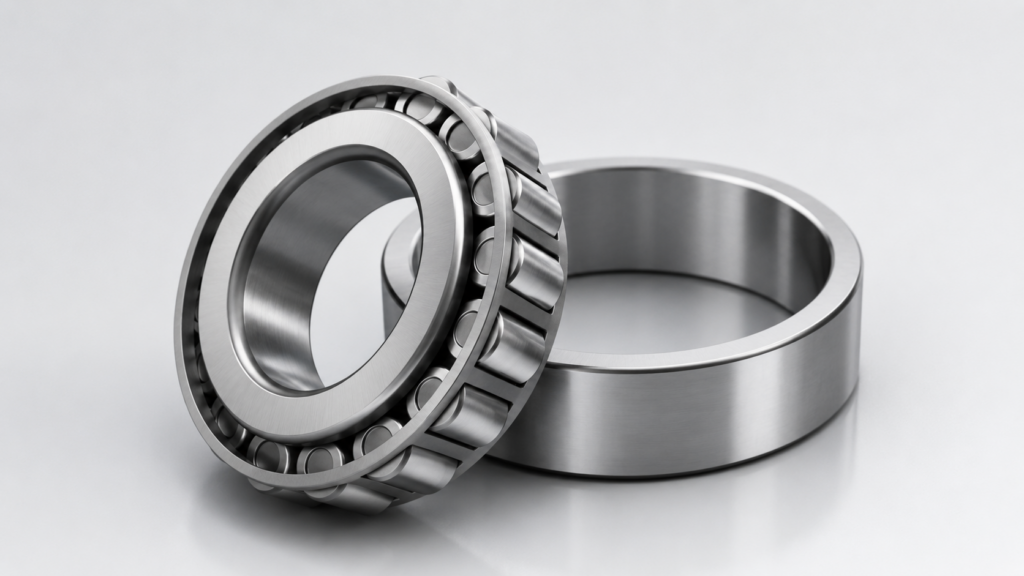
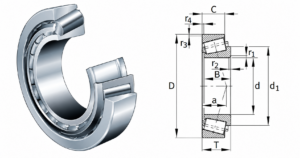
The 33022 is a single-row tapered roller bearing.
Its main components normally include:
* A solid inner ring with a tapered raceway
* A solid outer ring with a tapered raceway
* Tapered rollers
* A cage that separates and guides the rollers
Unlike a deep groove ball bearing, the 33022 contains tapered rollers rather than balls.
The tapered geometry allows the bearing to support high radial loads together with axial load in one direction.
Its axial load-carrying capability is related to the bearing contact angle. In general, a larger contact angle provides a higher axial load-carrying capability.
However, because a single-row tapered roller bearing supports axial load mainly in one direction, it is normally used with another bearing that locates the shaft in the opposite direction.
Why Must Single-Row Tapered Roller Bearings Be Adjusted?
A single-row tapered roller bearing is commonly installed:
* Opposite another single-row tapered roller bearing
* In an X arrangement
* In an O arrangement
* As part of a matched bearing set
* With an adjusting nut, calibrated shims, or spacers
During installation, the two opposing bearings must be adjusted to achieve the required axial clearance or preload.
The correct setting depends on factors such as:
* Bearing arrangement
* Shaft and housing design
* Operating load
* Rotational speed
* Working temperature
* Required shaft rigidity
* Lubrication method
* Equipment manufacturer’s instructions
Correct bearing adjustment helps maintain proper roller contact and shaft guidance.
An unsuitable setting can cause abnormal heat, vibration, sliding, noise, unstable shaft movement, or premature bearing damage.
What Happens If the Axial Clearance Is Too Large?
Excessive axial clearance allows too much axial movement within the bearing arrangement.
Under unstable, reversing, or changing loads, the rollers may not remain evenly loaded and correctly guided.
Possible consequences include:
Increased Roller Sliding
Rolling elements should primarily roll along the raceways.
If the bearing arrangement has excessive looseness or insufficient stabilizing load, the rollers may experience increased sliding instead of maintaining the intended rolling motion.
Sliding increases friction and can damage the roller and raceway surfaces.
Unstable Roller Guidance
Tapered rollers rely on the raceways, guide rib, cage, load, and correct bearing setting to maintain their intended position.
If the bearing arrangement is too loose, roller motion can become unstable.
This can lead to skewing, uneven contact, vibration, and cage stress.
Higher Cage Load
The cage is designed to separate and guide the rollers. It is not intended to correct severe roller instability caused by an improperly adjusted bearing arrangement.
Repeated roller impact or sliding can accelerate cage pocket wear.
In serious cases, the cage may deform, crack, or fracture.
Increased Heat and Noise
Excessive sliding and unstable contact can generate:
* Higher operating temperature
* Abnormal noise
* Vibration
* Wear particles
* Surface damage
These symptoms may appear before the rollers become visibly displaced.
Can Excessive Preload Also Damage the Bearing?
Yes.
It is incorrect to assume that only excessive clearance causes tapered roller bearing damage.
If the bearing is adjusted too tightly, the preload may become excessive.
Possible consequences include:
* Increased internal friction
* Rapid temperature rise
* Lubricant deterioration
* Raceway and roller surface damage
* Cage damage
* Reduced bearing life
* Bearing seizure in severe cases
The target is not simply to eliminate all clearance.
The bearing arrangement must be adjusted to the value specified for the actual equipment and operating condition.
Why Did the Rollers Become Skewed?
Visible roller skewing usually means that the roller-and-cage assembly is no longer operating normally.
The most likely areas to investigate are listed below.
1. Incorrect Axial Clearance
If the bearing arrangement was not correctly adjusted after installation, excessive axial clearance may have allowed unstable roller motion.
This is one of the main possible causes in this case.
2. Incorrect Preload
If the adjustment was too tight, excessive preload may have generated high friction and temperature.
Thermal expansion during operation can further change the effective bearing setting.
3. Loose Adjusting or Locking Components
A correctly adjusted bearing may lose its setting if:
* The locknut becomes loose
* A locking washer is not secured
* A retaining component moves
* A spacer is incorrect
* A housing cover becomes loose
The initial installation value should therefore be checked again after disassembly.
4. Rollers Were Not Correctly Seated During Installation
During tapered roller bearing adjustment, the shaft or bearing arrangement is commonly rotated so that the rollers settle into their correct operating positions.
If the rollers are not properly seated before the final adjustment, the measured axial clearance may be inaccurate.
The bearing setting can then change after the machine begins operating.
5. Cage Damage
The cage may have been:
* Damaged during transport
* Deformed during installation
* Scratched by incorrect tools
* Overloaded by unstable rollers
* Worn by inadequate lubrication
Once the cage pockets become damaged, the rollers may no longer remain evenly spaced or correctly guided.
6. Insufficient or Incorrect Lubrication
Lubrication helps reduce friction and sliding between contact surfaces.
Too little lubricant, an unsuitable lubricant, contaminated lubricant, or an incorrect lubrication method can increase:
* Sliding
* Friction
* Temperature
* Surface wear
* Cage stress
The lubricant type, quantity, cleanliness, and distribution should all be checked.
7. Shaft or Housing Dimensional Errors
Incorrect shaft or housing dimensions can affect:
* Bearing fit
* Ring deformation
* Alignment
* Axial setting
* Operating clearance
* Load distribution
The shaft seat, housing bore, shoulder squareness, surface condition, and dimensional tolerances should be measured.
### 8. Shaft Misalignment
Misalignment can cause uneven load distribution across the rollers.
Possible sources include:
* Shaft bending
* Housing misalignment
* Incorrect shoulder geometry
* Coupling misalignment
* Installation at an angle
* Deformation of the mounting structure
A tapered roller bearing has limited ability to tolerate alignment error.
9. Abnormal or Insufficient Load
Both abnormal overload and insufficient stabilizing load may affect roller motion.
The investigation should confirm:
* Actual radial load
* Actual axial load
* Load direction
* Shock loading
* Load fluctuation
* Machine vibration
* Rotational speed
The bearing selection should then be checked against the real operating conditions.
## How Is the Clearance of a Tapered Roller Bearing Measured?
For an adjusted tapered roller bearing arrangement, axial displacement is generally the key installation measurement.
The axial clearance is influenced by the position of the opposing bearing.
Depending on the machine design, adjustment may be completed using:
* A locknut
* Threaded adjusting rings
* Calibrated shims
* Housing covers
* Ground spacers
* A matched bearing set
A dial indicator may be used to measure the axial movement of the shaft or bearing arrangement.
The shaft should normally be rotated during the adjustment procedure so that the rollers settle against the raceways and guide ribs.
The final adjustment value should follow:
* The equipment manufacturer’s instructions
* The bearing arrangement drawing
* The specified endplay or preload
* The approved installation procedure
There is no single axial-clearance value that is correct for every 33022 application.
How Is the Clearance Set in a Matched Bearing Pair?
In some paired tapered roller bearing arrangements, the internal axial clearance or preload is determined by precision-ground spacers.
The spacer dimensions are selected or ground according to the required bearing setting.
This means that spacers should not be:
* Mixed between bearing sets
* Replaced with unverified parts
* Ground without calculation
* Installed in the wrong position
* Reused without dimensional inspection
Changing the spacer width changes the final axial clearance or preload of the bearing arrangement.
Matched bearings and their spacers should therefore be kept together as a complete set.
What Should Be Inspected After This Failure?
Because some rollers have already become visibly skewed, the bearing should be removed from service and inspected.
Inspect the Bearing
Check for:
* Skewed or displaced rollers
* Worn cage pockets
* Cracked or deformed cage sections
* Raceway scoring
* Roller surface damage
* Discoloration caused by heat
* Metal particles
* Rib wear
* Uneven contact patterns
Inspect the Installation
Confirm:
* Bearing mounting direction
* Arrangement of the two bearings
* Initial axial clearance
* Preload setting
* Locknut condition
* Locking-device condition
* Spacer dimensions
* Shim thickness
* Housing-cover position
Inspect the Shaft and Housing
Measure and check:
* Shaft diameter
* Housing bore
* Shoulder squareness
* Shaft straightness
* Housing alignment
* Seat roundness
* Surface damage
* Loose-fit marks
* Contact corrosion
Inspect the Lubrication
Record:
* Lubricant type
* Lubricant viscosity
* Grease or oil quantity
* Lubrication method
* Contamination
* Lubricant discoloration
* Operating temperature
* Lubrication interval
Review the Operating Conditions
Collect:
* Rotational speed
* Radial load
* Axial load
* Load direction
* Machine temperature
* Operating hours
* Vibration
* Shock load
* Startup frequency
These details are necessary for a reliable failure analysis.
Can the Damaged 33022 Bearing Be Reused?
A bearing with visibly skewed rollers should not be placed back into service without professional inspection.
If the cage, rollers, raceways, or guide ribs have been damaged, the bearing should normally be replaced.
Simply repositioning the rollers is not a reliable repair.
Even if the bearing appears to rotate again, hidden damage may remain on:
* Roller surfaces
* Raceway surfaces
* Cage pockets
* Guide ribs
Continuing to operate a damaged bearing can lead to sudden failure and secondary damage to the shaft, housing, gears, or other machine components.
Recommended Corrective Actions
For this case, the recommended procedure is:
- Stop using the damaged bearing.
- Disassemble the complete bearing arrangement.
- Inspect both opposing bearings.
- Check the cage, rollers, raceways, and guide ribs.
- Measure the shaft and housing seats.
- Verify the locknut, spacers, shims, and retaining components.
- Confirm the required axial clearance or preload.
- Check the lubricant and lubrication quantity.
- Review the real operating load and speed.
- Install a new bearing if internal damage is confirmed.
- Adjust the complete bearing arrangement according to the equipment specification.
- Monitor temperature, noise, and vibration during the trial run.
Do not replace only the visibly damaged bearing without checking the bearing on the opposite side.
The two bearings work together to establish the shaft’s axial position and operating setting.
Frequently Asked Questions
Does the 33022 bearing contain balls or rollers?
The 33022 is a tapered roller bearing. It contains tapered rollers, not balls.
Can a single 33022 bearing be used by itself?
A single-row tapered roller bearing normally supports axial load mainly in one direction. It is commonly used with another bearing that supports axial load in the opposite direction.
The final arrangement depends on the equipment design.
What is the most likely cause of roller skewing after two days?
Incorrect axial clearance or preload is an important possible cause, particularly if the bearing arrangement was not adjusted after installation.
However, cage damage, poor lubrication, loose locking parts, incorrect fits, misalignment, and abnormal loading should also be investigated.
Does excessive axial clearance damage tapered roller bearings?
Excessive axial clearance can reduce shaft guidance and may contribute to unstable roller movement, sliding, vibration, cage wear, noise, and heat under unsuitable operating conditions.
Can excessive preload cause bearing failure?
Yes. Excessive preload increases friction and operating temperature and can lead to lubricant deterioration, surface damage, and premature bearing failure.
How should tapered roller bearing clearance be measured?
The adjusted bearing arrangement is generally checked by measuring axial shaft movement using an appropriate measuring method, such as a dial indicator.
The exact procedure and target value should follow the equipment manufacturer’s specification.
Can the spacer determine the axial clearance?
Yes. In matched bearing arrangements, precision-ground spacers may establish the required axial clearance or preload.
The spacer must match the original bearing arrangement and installation requirements.
Can skewed rollers simply be repositioned?
No. Visible roller skewing may indicate cage or contact-surface damage.
The bearing must be disassembled and inspected, and it should be replaced if damage is found.
Conclusion
The 33022 is a single-row tapered roller bearing that normally works as part of an adjusted bearing arrangement.
If some rollers become skewed after only two days, the bearing has already entered an abnormal operating condition.
Incorrect axial clearance or preload is a major area to investigate, but it should not be treated as the only possible cause.
A complete inspection should include:
* Bearing adjustment
* Opposing bearing condition
* Locking components
* Cage condition
* Lubrication
* Shaft and housing dimensions
* Alignment
* Speed and load
The damaged bearing should be removed from service. Before installing a replacement, the root cause must be identified and corrected to prevent the same problem from happening again.
Need Help Analyzing a Tapered Roller Bearing Failure?
When requesting technical support, please provide:
* Complete bearing designation
* Equipment type
* Installation arrangement
* Rotational speed
* Radial and axial loads
* Lubrication method
* Operating temperature
* Axial-clearance or preload setting
* Photos of the bearing, cage, rollers, shaft, and housing
USU Bearing can assist with bearing selection, application analysis, OEM bearing solutions, and preliminary failure analysis.