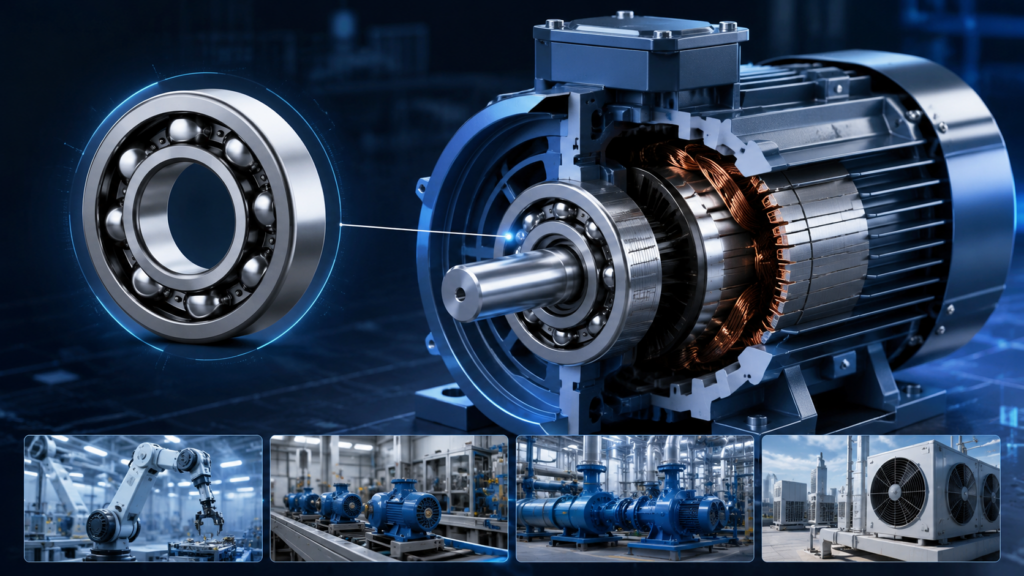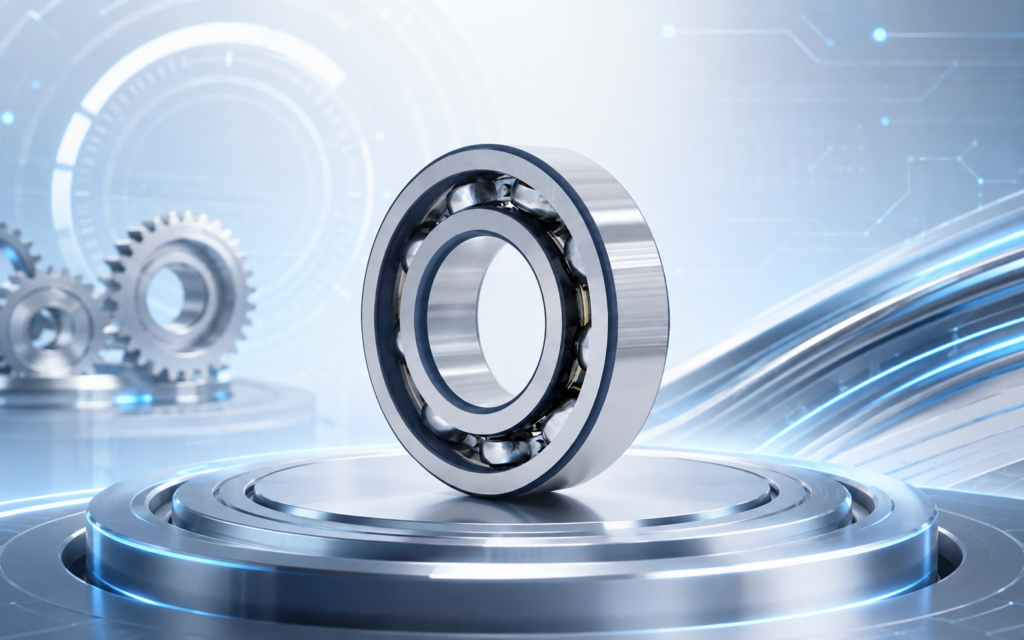




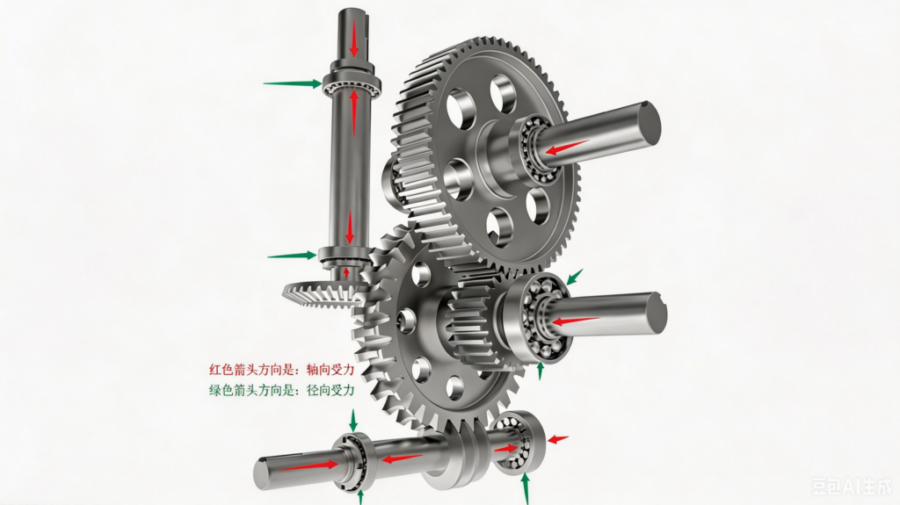
From the wooden shaft sleeves in Da Vinci’s manuscripts, to steel ball bearings of the Industrial Revolution, and to modern hybrid ceramic bearings —over 200 years, humanity has reduced the friction coefficient from 0.5 to 0.001!
From scooters and washing machines to high-speed railways and space stations, bearings interpret the mechanical philosophy of No friction, no progress through precise rotation. Wherever there is rotational movement, bearings are indispensable. Bearings are like the heart of the human body or the knee joints; without them, machinery cannot operate flexibly.
1.What Is a Bearing?
A bearing is a layer of rolling elements installed between two relatively moving metal parts. Simply put, a bearing is the core component that enables machinery to rotate smoothly.
Its core functions:
Reduce friction – Make rotating parts run more smoothly and reduce energy loss.
Bear loads – Support the weight of machinery and impact force during operation.
Maintain positioning – Ensure the rotating shaft runs steadily in place without offset.
Take a bicycle wheel axle as an example: without bearings, the wheel turns stiffly with loud noise and wears out quickly.
2.Structure and Composition of Bearings
Most bearings consist of four core components: inner ring, outer ring, rolling elements, and cage.
Inner ring: Fits on the shaft and rotates with it.
Outer ring: Fixed to the machine housing and remains stationary.
Rolling elements: Load-bearing steel balls or rollers sandwiched between inner and outer rings, rolling to reduce friction.
Cage: Evenly spaces rolling elements to prevent collision and damage.
Core Bearing Components
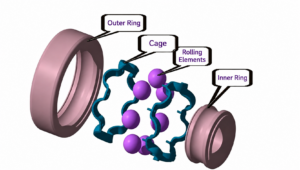
With these four parts, the bearing achieves ultra-smooth rotation.
3.Common Bearing Types and Applications
Bearings are mainly divided into ball bearings and roller bearings:
Ball bearings: Point contact between steel ball and raceway, ultra-low friction, perfect for high-speed operation.
Roller bearings: Line contact between roller and raceway, large contact area, ideal for heavy load and compression resistance.
Each type of bearing has its own advantages, detailed introduction as follows:
Deep Groove Ball Bearing
The most widely used and common type.
Features: Simple structure with double deep grooves, high rotational speed
Application: Motors, home appliances, office equipment, auto parts
Self-Aligning Ball Bearing
Mainly bears radial load.
Features: Spherical outer raceway for automatic self-alignment
Application: Woodworking machinery, textile machinery, agricultural machinery, ventilation equipment
Angular Contact Ball Bearing
Bears radial load and bidirectional axial load.
Features: High precision with optional 15°, 25°, 40° contact angles
Application: Machine tool spindles, woodworking machinery, precision instruments, high-speed machinery
Thrust Ball Bearing
Axial support for low and medium speed conditions.
Features: Simple structure, available in 3-piece / 5-piece assembly
Application: Crane hooks, low-speed heavy-duty equipment, vertical pumps, pressure machines
Spherical Roller Bearing
Adopts barrel rollers instead of steel balls, large contact area and strong load capacity.
Features: Barrel roller + spherical raceway, self-aligning and high load-bearing
Application: Vibrating screens, mining, wind power industry
Tapered Roller Bearing
Bears both radial load and axial thrust simultaneously.
Features: Sturdy and durable; single/double/four-row optional
Application: Automotive wheel hubs, construction machinery, mining equipment, heavy transmission devices
Cylindrical Roller Bearing
Cylindrical rollers replace steel balls, with large contact area and strong radial load capacity.
Features: High load capacity and rigidity; NU/NJ/NUP structural types
Application: Large motors, machine tool spindles, railway axle boxes, diesel crankshafts, automotive gearboxes
Thrust Spherical Roller Bearing
Features: Tapered barrel roller, strong axial load capacity, self-aligning
Application: Hydroelectric generators, vertical motors, marine propeller shafts, rolling mill reducers, tower cranes, coal mills, extrusion machines, forming machines
Thrust Roller Bearing
Features: 3-piece combined structure with rolling elements, cage and gaskets; high load capacity and impact resistance
Application: Hydraulic machinery, heavy-duty machinery, marine propulsion systems, large gearboxes
Insert Bearing
Features: Integrated spherical outer ring and housing with dust cover; easy to mount/dismount, suitable for dusty environments
Application: Agricultural machinery, conveying equipment, light industrial machinery, food machinery
Double-Row Deep Groove Ball Bearing
Features: Dual parallel deep groove design for higher load capacity
Application: Motors, water pumps, industrial gearboxes
Needle Roller Bearing
Features: Slender rolling elements, compact structure, small radial size, high load capacity
Application: Automotive transmissions, motorcycle engines, connecting rods, universal joints
Spherical Plain Bearing
Features: No rolling elements; spherical surface contacts arc surface directly, requires regular lubrication
Application: Construction machinery, hydraulic equipment, robots
Rod End Bearing
Features: Combined spherical plain bearing and rod; internal/external thread, regular/reverse thread
Application: Push rods, connecting rods, automation equipment
Quick Selection Guide
High speed & low noise → Choose ball bearings
Heavy load & impact resistance → Choose roller bearings
Shaft deflection & misalignment → Choose self-aligning bearings
Harsh dusty environment & frequent disassembly → Choose insert bearings
4.Importance of Bearings in Industrial Production
Energy Saving & Consumption Reduction – High-quality bearings cut power consumption and heat generation, saving considerable annual electricity costs.
Efficiency Improvement – High-precision bearings enable faster and more stable equipment operation, boosting production capacity.
Service Life Extension – Premium bearings reduce equipment downtime and greatly lower maintenance costs.
Operation Safety Guarantee – High-speed railways, elevators and wind power equipment all rely on reliable bearings for safe operation.
5.How Customers Select Bearings
Keep these 6 key points in mind for procurement, maintenance and equipment management:
What is the original bearing model? (Match original factory specification)
What is the monthly consumption? (Quantity determines bargaining space)
Operating temperature? (Normal / high / low temperature corresponds to special grease and cage materials)
Working environment? (Dust, moisture, corrosive gas or not)
Rotation speed and load? (High speed uses deep groove ball bearings; heavy load uses roller bearings)
After-sales maintenance requirement? (Expected service life and replacement policy)
Master these six points, and you will make the right bearing choice every time.
Closing Remarks
Small as bearings are, they support the entire industrial world.
A qualified bearing is not judged by appearance, but by internal quality — the roundness of steel balls, the hardness of rings, and the design of heat dissipation and sealing performance.
Wuxi USU Bearing Co., Ltd.
We specialize in bearing production and manufacturing.
Feel free to contact us for model selection, procurement and technical consultation.