



In the process of maintaining bearings and mechanical equipment, lubricating grease is one of the most widely applied lubrication materials. Whether in industrial equipment, electric motors, reducers, or agricultural machinery, lubricating grease plays a vital role in reducing friction, lowering temperatures, preventing rust, and providing a seal.
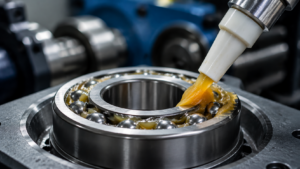
For equipment management and procurement personnel, understanding the basic concepts of lubricating grease is an essential foundation for correct model selection and scientific maintenance.
I. What is Lubricating Grease?
According to the definition by the National Lubricating Grease Institute (NLGI):
Lubricating Grease is a solid to semi-fluid product of dispersion of a thickening agent in a liquid lubricant. Other ingredients imparting special properties may be included.
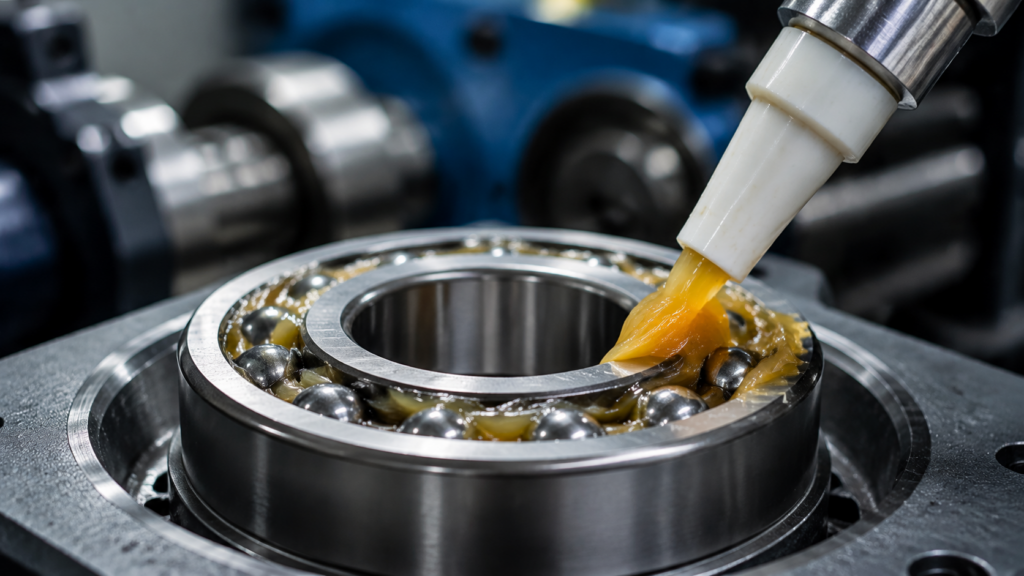
Simply put, lubricating grease is a lubricating medium with a certain consistency, formed primarily by adding a thickener to lubricating oil. Compared to liquid lubricating oils, grease is less prone to leakage, offers superior sealing performance, and allows for longer maintenance intervals. Therefore, it is widely used in bearing components that are inconvenient for frequent oil replenishment, vertically installed, or open to the environment.
II. What is the “Thixotropy” of Lubricating Grease?
Thixotropy is one of the most important physical characteristics of lubricating grease. When grease is subjected to an external mechanical shearing force, its internal fiber structure is temporarily disrupted, reducing shear resistance and demonstrating better fluidity. However, once the external force disappears (e.g., when the machine stops), the grease gradually recovers its original consistency.
It is precisely because of this property that lubricating grease can lubricate like oil when the equipment is running, yet will not leak out like oil when the machine stops. This is also the key reason why grease lubrication is preferred for many rolling bearings.
III. The “Three Core Components” of Lubricating Grease
The performance of a lubricating grease depends on its three core elements: Base Oil, Thickener, and Additives.
$$\text{Lubricating Grease (100\%)} = \text{Base Oil (70\%–95\%)} + \text{Thickener (5\%–30\%)} + \text{Additives (0\%–10\%))}$$
1. Base Oil (Determines Basic Lubricating Performance)
Base oil is the primary lubricating component in grease, typically accounting for 70% to 95% of the total weight.
Mineral Oil: Refined from petroleum, it offers stable lubricating performance, a wide range of viscosities, and low cost. Currently, most general-purpose industrial bearing greases still use mineral oil, though it has limitations under extreme high/low temperatures or ultra-high speeds.
Synthetic Oil: Manufactured through chemical methods, including synthetic hydrocarbons (PAO), esters, silicone oils, and fluorinated oils. It features an extremely wide operating temperature range, oxidation resistance, long service life, and suitability for ultra-high speeds. It is widely used in high-end precision bearings or special operating conditions.
2. Thickener (Determines Structure, Temperature Resistance, and Water Resistance)
The thickener acts as the “skeleton” of the lubricating grease, responsible for holding and absorbing the base oil internally like a sponge.
Soap-Based Thickeners (Most Common): These include lithium, lithium complex, calcium, sodium, and aluminum soaps. Among them, lithium and lithium complex greases are currently the most widely applied in the industrial bearing sector.
Organic Thickeners: Mainly polyurea, amides, etc. They feature excellent high-temperature resistance and are commonly used in long-life, maintenance-free operating environments such as electric motors.
Inorganic Thickeners: Such as bentonite clay, silica gel, and graphite. This type of grease does not melt at high temperatures and is suitable for ultra-high temperature or special heavy-duty environments.
3. Additives (Determine Special Functions)
To ensure the lubricating grease performs better under harsh operating conditions, an appropriate amount of additives is blended in.
Common Functions: Anti-wear (AW), extreme pressure (EP), anti-oxidation, anti-corrosion, rust prevention, and improved water resistance. For example, adding molybdenum disulfide ($\text{MoS}_2$) or graphite can significantly enhance a bearing’s heavy-load and shock-resistance capabilities.
IV. How to Choose Lubricating Grease Reasonably Based on Operating Conditions?
In bearing selection and maintenance, lubricating grease must be comprehensively evaluated in combination with the following operating conditions:
| Bearing Operating Conditions | Grease Selection Principles | Typical Application Suggestions |
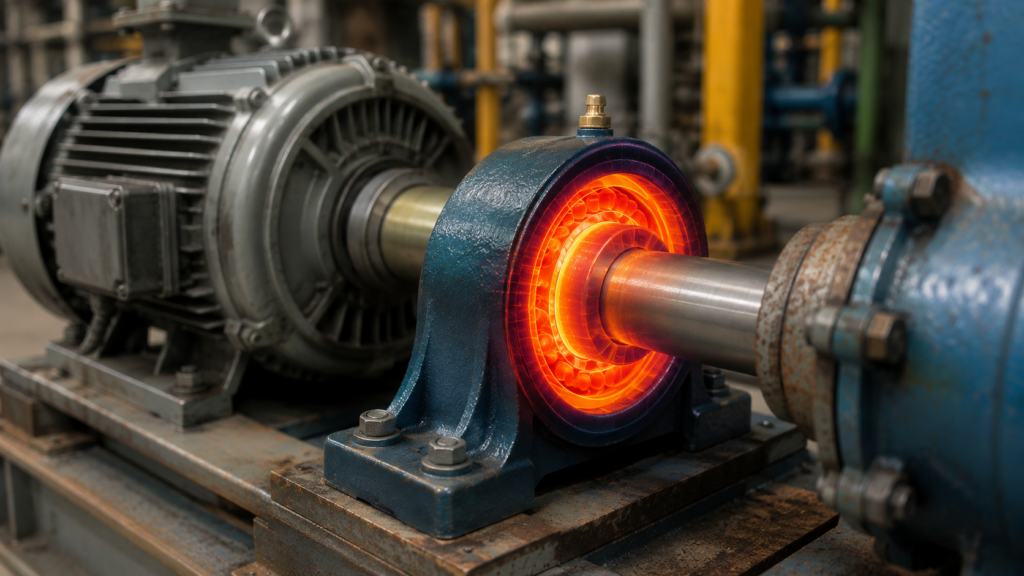
| High-Temperature Equipment / Long-term Operation | Prioritize synthetic oils, polyurea grease, or lithium complex grease. | High-temperature fans, electric motors, drying conveyor line bearings. |
| Heavy Load / Shock Load Equipment | Must select grease containing extreme pressure and anti-wear (EP) additives. | Mining machinery, rolling mill bearings, heavy-duty conveyors. |
| Humid / Water-Spray Environments | Select grease with strong water resistance (such as calcium-based, aluminum-based, or lithium complex). | Agricultural machinery, food packaging, washing equipment. |
| High-Speed Bearings | Select specialized high-speed grease with low base oil viscosity and low internal friction resistance. | Machine tool spindles, high-speed motor bearings. |
Conclusion
Although lubricating grease may seem like a minor detail in bearing matching, its quality and type directly determine whether mechanical equipment can run stably.
Choosing the right grease can double a bearing’s lifespan; choosing the wrong grease will cause even the best bearing to suffer premature burnout and wear.
As a professional industrial bearing supplier, Wuxi USU Bearings not only provides you with various high-precision, high-quality bearing products, but also continuously offers comprehensive technical solutions covering bearing lubrication, installation, maintenance, and industry applications.
If you encounter issues such as bearing overheating, rapid grease loss, or abnormal bearing noise during equipment operation, or if you need to obtain specific data matching lubricating grease with bearing models, please feel free to further communicate with the Wuxi USU Bearings technical team at any time.