



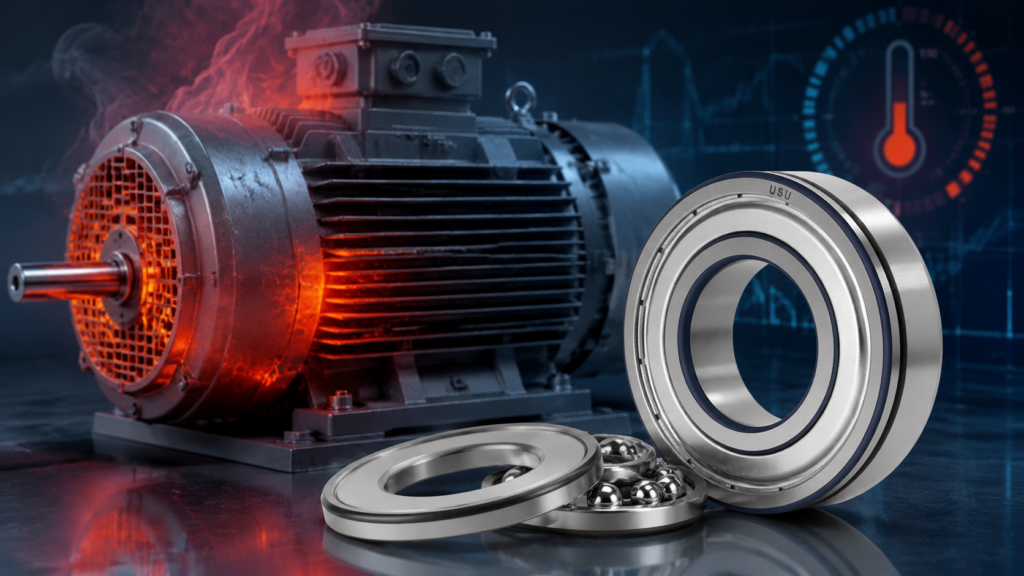
When a motor experiences a temperature rise after running for a period of time, many maintenance personnel will first suspect bearing damage. In fact, bearing failure is only one of the causes of motor overheating. Power supply quality, internal motor condition, equipment load, and ventilation conditions can all lead to abnormal motor temperatures.
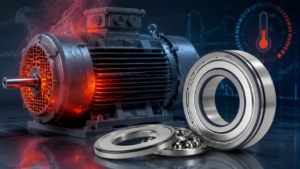
Therefore, when the temperature of the motor casing, end cover, or bearing area is found to be elevated, it is not recommended to immediately replace the bearing. Instead, a systematic investigation should be conducted, considering current, vibration, noise, and the operating environment.
I. Abnormal Power Supply Can Cause Motor Overheating
Motors require stable voltage and frequency conditions to operate. If the power supply quality is abnormal, the winding current and core losses will change accordingly, causing a temperature rise.
Common situations include:
Overvoltage: When the voltage exceeds the motor’s allowable range, the magnetic flux density in the core increases, leading to increased iron losses and excitation current, easily causing the windings and core to overheat.
Undervoltage:*When the load remains constant but the voltage decreases, the motor usually needs to increase the current to maintain output, resulting in increased winding temperature.
Single-Phase Operation
When a single phase is lost in a three-phase motor, the remaining windings will carry a larger current, potentially causing the motor to overheat rapidly and, in severe cases, burn out the windings.
Three-Phase Voltage Imbalance
When there is a significant difference in the three-phase voltage, the current in each phase will also become unbalanced, causing local winding overload and additional temperature rise.
During troubleshooting, the power supply voltage, current, and frequency should be measured first to confirm that the power supply conditions meet the motor’s rated requirements.
II. Internal Motor Faults Can Also Cause Temperature Rise
If the power supply is normal, the next step is to check the motor itself.
Incorrect Wiring Method
Incorrect use of star or delta connections may cause the winding voltage to deviate from design requirements, resulting in abnormal current and winding overheating.
Winding Short Circuit or Ground Fault
When a short circuit occurs between turns, between phases, or to ground in the windings, the current will increase significantly, accompanied by three-phase current imbalance.
Stator-Rotor Friction
Rotor eccentricity, shaft bending, abnormal bearing position, or poor assembly may cause friction between the stator and rotor, generating heat and abnormal noise.
Rotor Component Damage
A broken conductor bar in a squirrel-cage rotor or a broken wire in a wound rotor will cause a decrease in the motor’s output capacity. To maintain the load, the current may continue to increase, eventually leading to overheating.
III. How do bearing problems cause excessive motor temperature?
While bearings are not the only cause of motor overheating, the following problems can indeed cause the motor temperature to rise:
Insufficient Lubrication or Ineffective Grease
Insufficient, aged, contaminated, or improperly selected grease will increase friction between the rolling elements and raceways, causing the bearing to overheat.
Excessive Grease Filling
More grease is not always better. Excessive filling increases stirring resistance and can easily cause temperature rise at high speeds.
Inappropriate Bearing Clearance
Insufficient clearance may cause the bearing to expand under heat, resulting in additional preload and a continuous increase in friction and temperature; excessive clearance may cause vibration and uneven load distribution.
Poor Installation or Fit
Incorrect bearing press-fitting force, misalignment between the shaft and bearing housing, excessively tight fit, or shaft bending can all cause abnormal bearing stress.
Bearing wear or spalling: Damage to the raceway, rolling elements, or cage will increase bearing running resistance, vibration, and noise, accompanied by localized temperature increases.
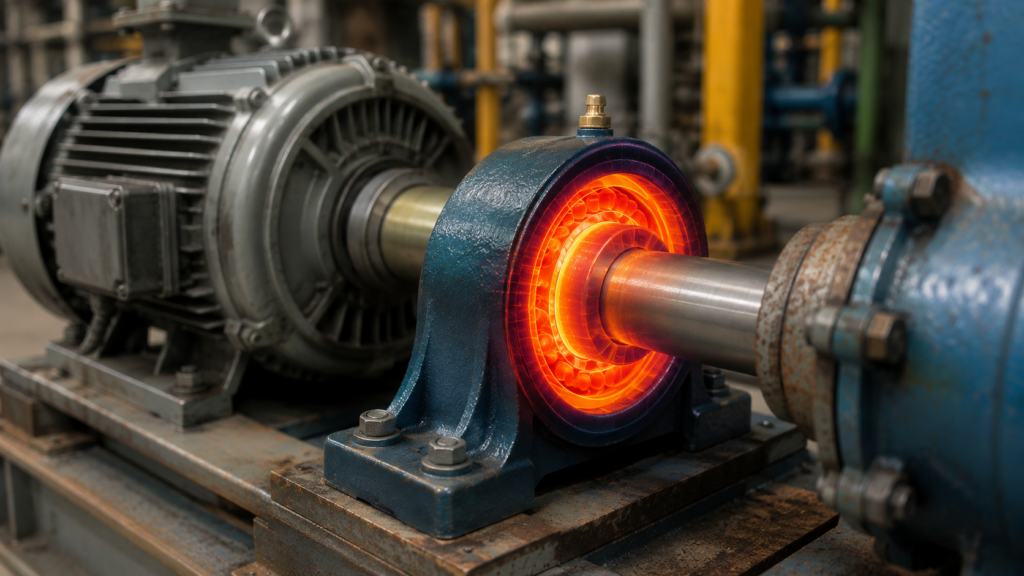
If the heat is mainly concentrated near the motor end cover or bearing housing, and is accompanied by abnormal noise, vibration, or increased rotational resistance, the bearing is likely faulty.
IV. Abnormal load is a common cause of motor overheating: Prolonged operation of the motor beyond its rated capacity will also cause continuous temperature rise.
Common problems include: prolonged motor overload operation, excessively frequent starts, excessively long start times, excessive resistance in the transmission mechanism, jamming of load equipment such as pumps, fans, and reducers, excessively tight belts, and misalignment of shafts.
During troubleshooting, the motor can be temporarily separated from the load equipment for a no-load test. If the no-load temperature is normal, the driven equipment and transmission system should be the focus of inspection.
V. Environmental and heat dissipation conditions cannot be ignored: The heat generated by the motor needs to be dissipated through fans, air ducts, and the casing. If heat dissipation is poor, even if the motor and bearings themselves have no obvious faults, overheating may occur.
High ambient temperature
High ambient temperature around the motor reduces heat dissipation efficiency, causing the overall operating temperature to rise.
Fan damage or incorrect rotation
A detached, damaged, insufficiently rotating, or incorrectly installed cooling fan will all affect ventilation.
Blocked air ducts
Dust, fibers, oil, etc., blocking the air inlet, fan cover, or heat sink prevent heat from being dissipated in time.
Damaged heat dissipation structure
Damaged heat sinks on the motor casing, incorrectly installed baffles, or insufficient space around the equipment will also cause poor heat dissipation.
Therefore, regularly cleaning the motor surface and air ducts is an important maintenance measure to control temperature rise.
VI. How to troubleshoot excessively high motor temperature?
When abnormal motor temperature is detected, check the following in order:
1. Measure three-phase voltage, current, and frequency;
2. Check if the motor has been under prolonged overload or frequently started;
3. Check the fan, air duct, and heat sink;
4. Listen for abnormal noise from the bearing area;
5. Detect bearing housing vibration and temperature;
6. Check the condition and amount of grease;
7. Check the alignment of the shaft with the load equipment;
8. If necessary, stop the machine and disassemble and inspect the bearings and internal motor components.
During the troubleshooting process, record the temperature trend, rather than observing the temperature at a single point in time. A sustained temperature rise is usually more valuable for diagnosis than a single measurement.
USU Bearings Motor Bearing Solutions
Targeting the characteristics of high-speed, low-noise, and long-term continuous operation of motors, USU Bearings offers a variety of motor bearing products and application support, including: deep groove ball bearings, low-noise motor bearings, ZZ dust cover bearings, 2RS sealed bearings, C3 and other bearings with different clearances, high-speed and long-life lubrication solutions, OEM branding and packaging customization, and bearing selection and fault analysis support.
USU Bearings can assist customers in selecting appropriate bearing structures, clearances, and sealing methods based on the motor’s speed, load, temperature, and installation conditions, reducing motor temperature rise and the risk of unplanned downtime.
Conclusion
Overheating of motors is not always caused by bearings. Power supply abnormalities, winding faults, equipment overload, and poor ventilation can all cause motor overheating.
Only by comprehensively analyzing current, vibration, noise, temperature, and lubrication conditions can the cause of the fault be accurately identified. Blindly replacing bearings may not only fail to solve the problem but also increase unnecessary maintenance costs.
USU Bearings is committed to providing global customers with stable and reliable motor bearing products and professional technical support to help equipment achieve low noise, low temperature rise, and long-term stable operation.