



The cage of a bearing is not only the “framework” that separates and holds the rolling elements, but also a key component that directly affects bearing wear resistance, limiting speed, and impact resistance. This article provides a detailed introduction to the differences between various cage structures in Self-aligning Roller Bearings and explains which types are suitable for different equipment applications.
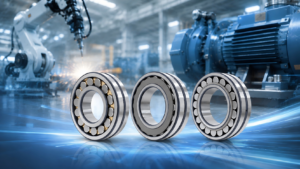
1. What Is the Core Function of a Bearing Cage?
Before discussing specific bearing models, let’s first look at the three core functions of cages in Self-aligning Roller Bearings:
Separation and Friction Reduction
The cage dynamically separates the rolling elements and maintains proper spacing, preventing collisions and surface damage between rollers, thereby significantly reducing friction resistance.
Uniform Load Distribution
The cage guides the rolling elements to distribute evenly, ensuring balanced load distribution during operation and avoiding localized stress concentration.
Improved Bearing Operation
In the unloaded zone of the bearing, the cage effectively guides the rolling elements, preventing destructive sliding or skidding and optimizing overall operating conditions.
2. Detailed Introduction to Four Main Self-aligning Roller Bearings Cage Structures
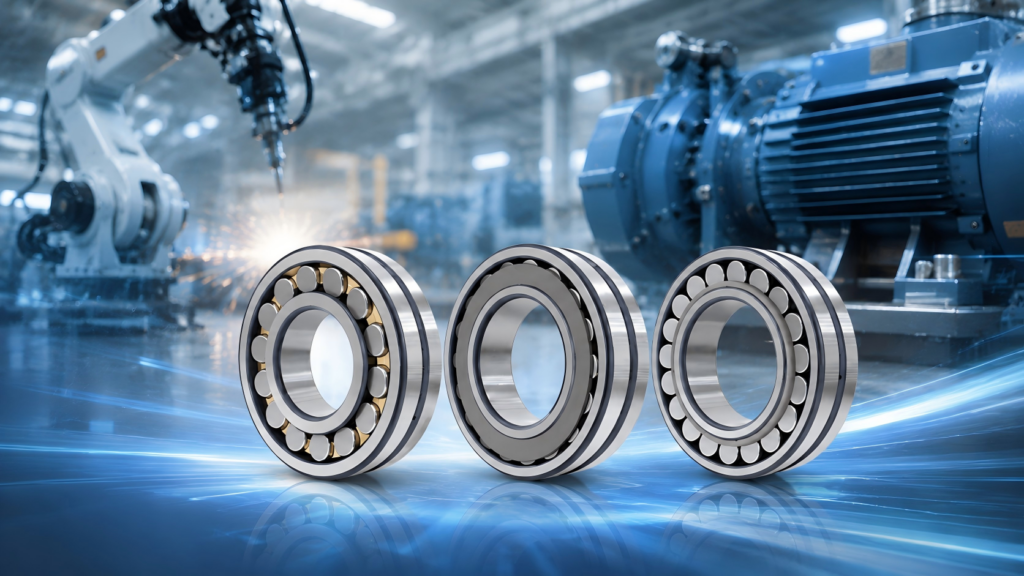
The cages of spherical roller bearings are mainly divided into two categories: pressed steel cages and machined brass cages. Based on different internal designs, four classic structures have been developed.
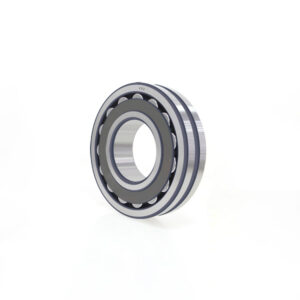
1. CC Type Bearing: The Balance Between Lightweight Design and High Load Capacity
Features
- Equipped with two window-type pressed steel cages
- Inner ring without flanges
- Floating guide ring guided by the inner ring
Models
The standard suffix is C or CC. For large bearings, EC or ECC indicates an optimized internal design with higher load-carrying capacity.
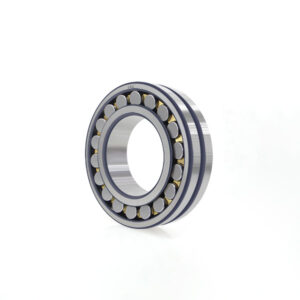
2. CA Type Bearing: The Traditional High-Rigidity Solution
Features
- Uses a one-piece finger-type machined brass cage
- Inner ring equipped with locating flanges on both sides
- Floating guide ring guided by the inner ring
Advantages
During bearing installation or maintenance, the flanges on the inner ring securely retain the rollers and prevent them from falling out.
Models
The suffix is CA. For large bearings, the ECA suffix indicates significantly upgraded load performance.
3. E Type Bearing: The New-Generation High-Efficiency Design
Features
- Equipped with two window-type pressed steel cages
- Inner ring without flanges
- Outer ring designed with lubrication groove and three lubrication holes, making grease or oil circulation more convenient
Guiding Method
- When bearing bore diameter d ≤ 65 mm, the floating guide ring is guided by the inner ring
- When d > 65 mm, the guide ring is guided by the cage
Performance
All bearings with the E suffix feature optimized internal structures and extremely high load capacity.
4. MB Type Bearing: The Industry Expert for Heavy Load and Vibration Resistance
Features
- Uses two open-type machined brass cages
- Inner ring equipped with side flanges and a center flange
Function
The flanges on the MB type inner ring are mainly designed to retain the rollers during installation and maintenance, rather than guiding the rollers or carrying axial loads.
Models
Small and medium-sized bearings usually use the 8MB suffix, while optimized large bearings use the MB suffix.
3. Materials and Manufacturing Processes: Pressed Steel vs. Machined Brass
Different manufacturing processes and materials provide bearings with completely different operating characteristics and application suitability.
| Cage Type | Main Material | Structure Types | Core Advantages | Typical Applications |
| Pressed Steel Cage | High-quality carbon steel sheet | CC, E | Lightweight, excellent toughness, compact design, beneficial for lubricant flow and retention | Commonly used in small and medium-sized rolling bearings |
| Machined Brass Cage | High-strength cast brass | CA, MB | Extremely high strength, excellent vibration resistance, low friction coefficient, fast heat dissipation | Widely used in medium, large, and extra-large bearings |
4. How to Select the Right Cage Type for Complex Working Conditions?
In practical industrial applications, if the operating environment is relatively stable and free from severe impact loads, CC, CA, E, and MB type bearings can all perform effectively. Selection can then be based on cost considerations and delivery schedules.
However, for harsh applications involving severe impact loads — such as mining vibrating screens, crushers, and heavy-duty cranes — split cage structure bearings such as MB and E types are strongly recommended.
Their excellent vibration resistance and robust structure can effectively prevent cage fracture and ensure continuous equipment operation.
Thank you for your attention to Wuxi USU Bearing.
With years of experience in the bearing industry, we are committed to providing high-quality, high-reliability bearing products and professional technical solutions. If you have any questions regarding Self-aligning Roller Bearings selection, installation, or lubrication methods, please feel free to contact us for further communication.